
If you use AI in healthcare, you usually need to check four rule sets at once: FDA, HIPAA, ONC/CMS, and internal governance. That’s the short answer.
By 2024, more than half of U.S. hospitals were already using or planning generative AI in EHR-linked settings. At the same time, many hospitals using predictive AI had not tested those models for bias in a consistent way. So if I were setting a healthcare AI review process, I would start with one simple question: What does the tool do, what data does it touch, and where does it sit in care delivery?
Here’s the article in plain English:
- FDA applies when AI works like medical device software, such as diagnosing, treating, or helping prevent disease.
- HIPAA applies when the system creates, receives, stores, or sends PHI.
- ONC and CMS matter when AI affects certified health IT, EHR workflows, or coverage decisions.
- Joint Commission guidance points health systems toward governance, local testing, event reporting, and staff training.
- NIST AI RMF and OECD principles help turn separate legal duties into one review and monitoring process.
A few points matter most before launch:
- Check whether the AI is device software or may fit the CDS carve-out.
- Confirm whether a vendor needs a Business Associate Agreement (BAA).
- Review model details, validation, update rules, and human review steps.
- Track drift, performance changes, and bias after go-live, not just before it.
| Area | What I would ask first | Main concern |
|---|---|---|
| FDA | Is this AI making or supporting a medical decision in a way that may make it device software? | Product safety |
| HIPAA | Does it handle PHI or ePHI? | Privacy and security |
| ONC / CMS | Does it affect EHR functions or coverage review? | Health IT and care delivery rules |
| Governance | Who owns it, tests it, watches it, and documents it? | Oversight across the life cycle |
Bottom line: healthcare AI compliance is not one checklist. It’s a layered review process that should happen before deployment and again whenever the model, workflow, vendor setup, or rule set changes.
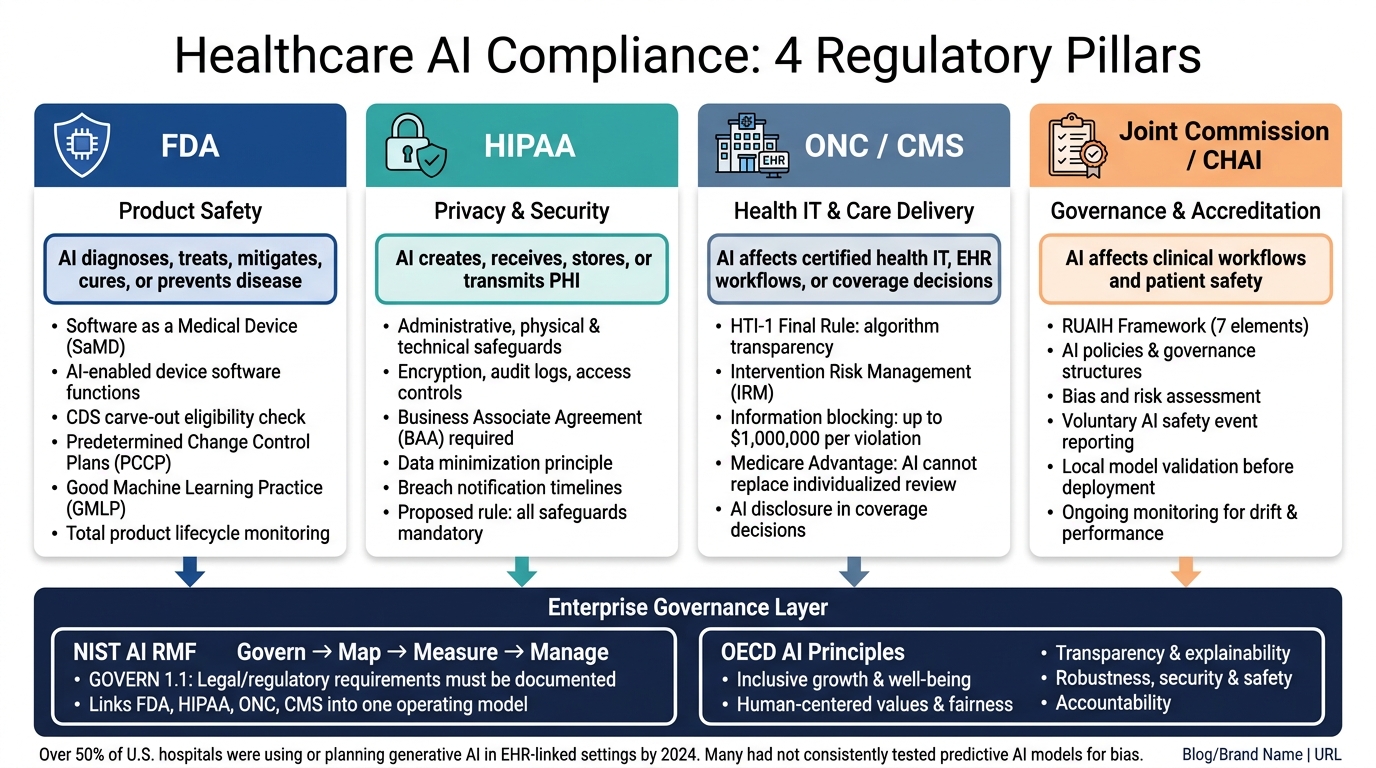
Healthcare AI Compliance: 4 Regulatory Pillars at a Glance
FDA Standards for AI-Enabled Medical Devices and Software
When Healthcare AI Falls Under FDA Oversight
FDA sits on the product-safety side of the equation. Its first question is simple: what is the software meant to do? Under section 201(h) of the FD&C Act, software becomes a medical device when it is meant to diagnose, treat, mitigate, cure, or prevent disease.[9][10][20]
FDA uses two closely linked ideas to draw that line. Software as a Medical Device (SaMD) means software that serves a medical purpose on its own, without being part of a hardware device. That can include a cloud-based AI tool that reads CT scans for lung nodules or a sepsis prediction model running inside an EHR.[20][18] AI-enabled device software covers device software functions that use AI models.[15][16]
For healthcare organizations, the issue goes beyond labels. The practical question is whether the vendor can show controlled design, validation, and post-market monitoring to mitigate enterprise risk.
Some software may stay outside FDA device rules. If a tool only displays, filters, or organizes data - or gives recommendations that a clinician can independently review - it may fit the Cures Act CDS carve-out if it meets all four statutory criteria.[6][17][19] That line matters in day-to-day operations. Tools outside the carve-out need full device compliance. Tools inside it do not. So before a health system buys anything, it needs the classification right.
Key FDA Guidance Documents and Recurring Compliance Themes
FDA follows a total product life cycle model. In plain English, that means compliance does not stop at launch. It covers design, deployment, updates, and monitoring.[4][23] The FDA's 2021 AI/ML-Based SaMD Action Plan focuses on five recurring themes: adaptive algorithms, Good Machine Learning Practice (GMLP), transparency, evaluation methods, and real-world performance monitoring.[7][8][1][14]
These documents show how FDA expectations run across the full product life cycle:
| FDA Document | Scope | Lifecycle Stage | Compliance Focus |
|---|---|---|---|
| AI/ML-Based SaMD Action Plan | AI/ML SaMD | Full lifecycle | Adaptive algorithms, GMLP, PCCPs, real-world monitoring |
| Clinical Decision Support Guidance | CDS software functions | Premarket / classification | Device vs. non-device boundary; independent review test |
| GMLP Guiding Principles (FDA, Health Canada, MHRA) | AI/ML device development | Design and validation | Representative data, human-AI team performance, transparency |
| Predetermined Change Control Plans (PCCP) Guidance | Adaptive AI devices | Post-deployment / updates | Pre-approved change types, validation methods, user communication |
| AI-enabled device software functions guidance | AI-enabled device software | Full lifecycle | Intended use, design controls, documentation, lifecycle management |
GMLP principles map directly to controls that hospitals and health systems can ask for. The 10 principles, developed by the FDA, Health Canada, and the UK's MHRA, stress representative datasets, clear separation between training and test data, validation under clinically relevant conditions, attention to how the human-AI team performs, and plain communication about algorithm updates.[11][12][13] Before deployment, health systems should ask vendors to show their GMLP evidence through automated vendor solutions.
Change management is another spot where risk can sneak up on people. AI models that learn or change after deployment do not fit the old static approval model very well. FDA's answer is the Predetermined Change Control Plan (PCCP). This plan is filed with the original marketing application and spells out which post-market changes are allowed, how those changes will be validated, and how users will be told about them.[21][22][24]
PCCPs give manufacturers room to roll out approved updates without filing again for every single change. That cuts regulatory drag while keeping updates inside a defined safety boundary.[25][26][27] For buyers, that means procurement should include a hard look at the PCCP, and production deployment should only happen after the organization checks that the update stays within the approved scope.
That same life cycle control ties directly into the privacy, security, and governance standards covered next.
sbb-itb-535baee
HIPAA, Health IT Rules, and Accreditation Requirements
How HIPAA Applies to AI Systems That Handle Protected Health Information
Once an AI system touches PHI, the focus shifts. It’s no longer just about product safety. Now privacy, security, and care-delivery oversight are in play.
HIPAA applies when an AI system creates, receives, maintains, or transmits protected health information (PHI) for a covered entity or business associate[31][34]. That includes ambient documentation, coding, prior authorization, messaging, and EHR-integrated cloud tools. Put simply, calling something “AI” does not change the HIPAA test.
The HIPAA Security Rule requires administrative, physical, and technical safeguards for electronic PHI (ePHI). In practice, AI deployments need controls such as access restrictions, unique user IDs, encryption, audit logs, and integrity checks[36][37][5]. Proposed Security Rule updates would make all safeguards required, not optional, so organizations should review controls for every system that processes ePHI[33][35].
Data minimization matters here too. Use only the PHI needed for the task. If limited data will work, don’t send the full chart[28][30]. It also helps to build privacy into the system from the start, especially in prompts, retention settings, and dataset separation[29].
If a vendor handles PHI for a covered entity, that vendor is usually a business associate. That means a Business Associate Agreement (BAA) needs to be signed before any ePHI is shared[29][32]. For AI services, the BAA should spell out:
- permitted uses and disclosures
- subcontractor flow-down duties
- breach notification timelines
- PHI retention and destruction terms
- whether training or tuning on client PHI is allowed[29][32][5]
ONC, CMS, and Joint Commission Standards That Affect AI in Care Delivery
When AI sits inside certified health IT or clinical workflows, HIPAA is only part of the picture. ONC, CMS, and accreditation standards also matter.
ONC’s HTI-1 final rule added transparency duties for predictive decision support interventions (DSIs) in certified health IT[44][45]. Certified developers must disclose key model details, including purpose, intended use, training and validation data, performance, bias, and maintenance. They also need Intervention Risk Management (IRM) practices that address validity, fairness, reliability, robustness, safety, and security[45][46][47][49][52]. If they don’t comply, ONC certification can be suspended, which can then affect CMS participation[44][46].
ONC’s information blocking rules add another risk layer. Practices that interfere with access to electronic health information can lead to civil monetary penalties of up to $1,000,000 per violation for developers and health information networks[44][48].
CMS has also drawn a clear line for Medicare Advantage organizations. AI tools may support utilization management, but they cannot replace individualized clinical review[50][51]. Coverage decisions must reflect the patient in front of the reviewer, not just the model’s output. Plans should also disclose how AI shapes those decisions[50][51][53].
The Joint Commission and CHAI released RUAIH, a nonbinding AI governance framework for health systems[2][40][42][43]. It lays out seven elements:
- AI policies and governance structures
- patient privacy and transparency
- data security and data use protections
- quality monitoring over time
- voluntary reporting of AI safety events
- risk and bias assessment
- education and training[2][38][41][42]
RUAIH treats AI-related safety events much like patient safety events and urges health systems to send AI incidents through existing safety reporting channels[42][41]. It also recommends local validation of models using each health system’s own data and workflows before deployment, followed by continued monitoring for drift, performance decline, and bias after launch[39][42].
Different agencies use different language, but the pattern is pretty clear: transparency, human review, and steady monitoring show up again and again.
| Body | Key Rule or Guidance | Core Compliance Focus |
|---|---|---|
| ONC | HTI-1 Final Rule | Algorithm transparency, IRM, information blocking |
| CMS | Medicare Advantage utilization management guidance | Individualized review, AI disclosure, non-discrimination |
| Joint Commission / CHAI | RUAIH Framework | Governance, bias review, safety event reporting, monitoring |
Cross-Cutting AI Governance Frameworks That Support Compliance
NIST AI RMF and OECD Principles as Organizing Frameworks
FDA, HIPAA, ONC, CMS, and the Joint Commission each cover one part of AI risk. On their own, they don't give healthcare teams a complete way to govern AI. That's where cross-cutting frameworks come in. They help turn separate legal duties into one working model.
The NIST AI Risk Management Framework (AI RMF) is a voluntary, cross-sector framework built to help organizations manage AI risk across the full lifecycle by building trustworthiness into how systems are designed, used, and monitored.[54][57][58] It centers on four functions: Govern, Map, Measure, and Manage.[56][57] In plain terms, Govern sets accountability, Map catalogs systems and risks, Measure assesses cybersecurity risk, and Manage addresses and reduces it.[57][58][63]
For healthcare organizations, NIST works as the implementation layer for the FDA, HIPAA, ONC, and CMS duties already discussed. One detail matters a lot here: NIST's GOVERN 1.1 says that legal and regulatory requirements tied to AI must be understood, managed, and documented.[3] That makes the framework a practical link between compliance on paper and the work people do every day.
The OECD AI Principles lay out the core values that trustworthy AI should reflect: inclusive growth and well-being; human-centered values and fairness; transparency and explainability; robustness, security and safety; and accountability.[55][61][62][64] In healthcare, those ideas line up with the same themes that keep coming up across compliance efforts: transparency, fairness, and accountability.
That sounds abstract until you put it into practice. It can mean:
- model cards that explain data sources and known limits
- routine bias reviews stratified by race, sex, and age
- clear explanations for clinicians and patients about what an AI tool does and doesn't do[58][63][59][65]
What Governance Research Shows About Oversight Gaps and Maturity
In practice, the main problem usually isn't a lack of policy. It's weak oversight. Implementing a unified risk operations team can help bridge these gaps. Research on healthcare AI governance keeps pointing to the same gaps: missing AI inventories, documentation that covers technical specs but leaves out clinical context and data provenance, validation that stops at deployment instead of continuing as patient populations change, bias reviews that happen once instead of over time, and audit trails that are often incomplete.[58][59][60][63][65]
Those gaps create a basic problem. If you can't track what the system is, how it was tested, what data shaped it, or how its performance changes, you can't show compliance or watch for drift.
ECRI's 2024 Top 10 Health Technology Hazards flags weak AI governance in medical technologies as a major patient safety hazard.[66][67][68] ECRI also recommends AI registries that track performance against clinician judgment and record encounter context.[67][69]
The strongest governance programs don't treat these frameworks like rivals. They use them together. NIST AI RMF provides the operating structure. OECD principles provide the value lens. FDA, HIPAA, ONC, CMS, and Joint Commission rules supply the legal details. Put together, they help close the gap between regulation and day-to-day oversight.
Enterprise AI: What Health Care Organizations Need to Know About Governance, Compliance, Vendor Risk
Conclusion: How These Standards Fit into a Healthcare AI Governance Framework
These standards work best when you use them as one operating model, not a stack of separate tasks. In practice, healthcare AI compliance is a layered model:
- FDA for product safety
- HIPAA for PHI
- ONC/CMS/Joint Commission for care delivery
- NIST/OECD for enterprise governance
NIST and OECD sit at the governance layer and help connect the legal standards into one system.
That setup only holds up if each AI use case is mapped before launch. Every use case should be reviewed across all four pillars before deployment, then checked again when the model, workflow, or rules change.
A centralized intake process makes that work far more practical. Censinet RiskOps™ can support centralized intake and assessment of AI vendors and clinical applications by bringing FDA status, PHI exposure, EHR integration points, and security controls into one workflow, then routing findings to the right stakeholders.
The goal is one connected governance framework, not a pile of isolated checklists. Compliance is strongest when product safety, privacy, clinical oversight, and enterprise risk management are governed together.
FAQs
How do I know if a healthcare AI tool needs FDA review?
Start by looking at what the tool is meant to do.
If it’s built to diagnose, treat, or prevent disease, it will usually count as Software as a Medical Device (SaMD). That means it needs FDA authorization through a path like 510(k), De Novo, or PMA.
Some tools don’t fall into that bucket. For example, products aimed at general wellness, or tools that don’t directly shape clinical decisions, may be exempt.
So don’t take a vendor’s word for it. Ask for:
- formal FDA clearance documentation, or
- a written legal explanation showing why the product is exempt
That one step can save a lot of trouble later, especially when a product sits in a gray area.
When does an AI vendor need a BAA under HIPAA?
A Business Associate Agreement (BAA) is required any time an AI vendor handles, processes, or can access PHI for a healthcare organization. That includes AI tools that use ePHI for operation, training, monitoring, or maintenance.
The timing matters here. The BAA must be signed before any PHI is shared.
If a vendor won't sign a BAA that covers its AI services, that tool should not be used with patient data.
What should we monitor after an AI tool goes live?
After an AI tool goes live, healthcare teams need to move from pre-deployment testing to continuous monitoring.
That means watching performance and accuracy for drift or drop-offs, checking equity and bias across patient groups, and looking closely at workflow effects like over-reliance or bottlenecks. Teams should also monitor security events, audit trail integrity, and vendor compliance.
Just as important, set clear intervention thresholds and escalation paths so people know when to step in and what to do next. In some cases, that may mean pausing the model or rolling it back fast.
