
If I had to boil this down to one point, it’s this: HIPAA alone is not enough to judge cloud security. I need a benchmark that turns broad HIPAA rules into checks I can test, document, and show to auditors, customers, and vendors.
Here’s the short answer:
- HITRUST CSF is the best fit when I need a healthcare-focused certification signal.
- NIST SP 800-53 is the best fit when I need deep control detail and internal risk tracking.
- CIS Controls and CIS Benchmarks are the best fit when I need fast hardening for cloud systems.
- CSA CCM is the best fit when I need to review cloud vendors and sort out shared responsibility.
- ISO/IEC 27001 + 27017 are the best fit when I need a formal ISMS and cloud governance across teams or regions.
A few healthcare cybersecurity benchmarking metrics make the tradeoffs clear:
- HITRUST e1: about $30,000–$50,000 over 3–6 months
- HITRUST r2: about $100,000–$400,000+ over 9–18 months
- NIST SP 800-53 Rev. 5: 1,000+ controls across 20 families
- CSA CCM v4.1: 207 controls across 17 domains as of January 27, 2026
- ISO 27001 certification: usually 3 years with annual surveillance audits
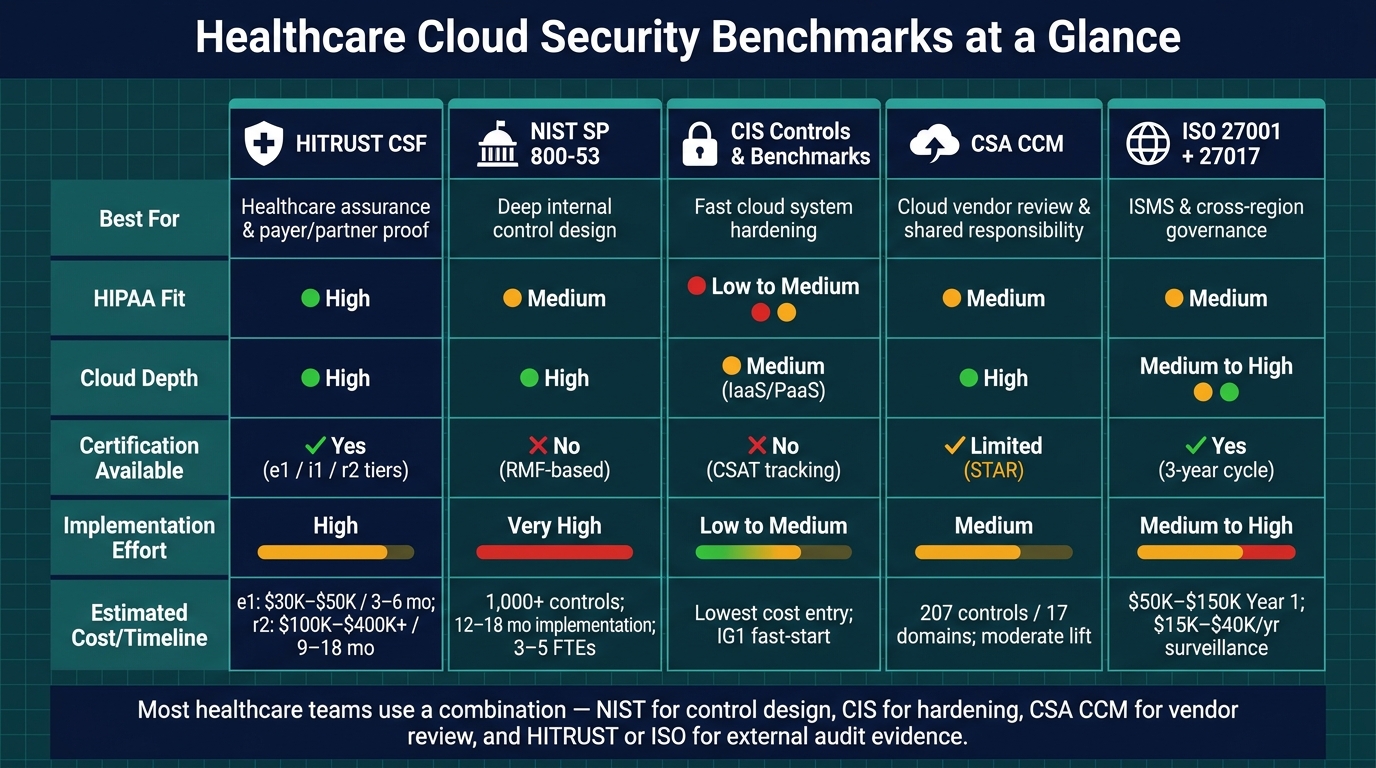
Healthcare Cloud Security Benchmarks Compared: HITRUST vs NIST vs CIS vs CSA vs ISO
CIS Benchmarks - A Best Practice for Cloud Security
sbb-itb-535baee
Quick take
If you work in healthcare IT, I’d think about these benchmarks like this:
- Need proof for payers or partners? Pick HITRUST.
- Need a deep internal control baseline? Pick NIST.
- Need to lock down cloud configs now? Pick CIS.
- Need a clean way to review cloud vendors? Pick CSA CCM.
- Need audit-ready governance across the business? Pick ISO 27001/27017.
Quick Comparison
| Benchmark | Best for | HIPAA fit | Cloud depth | Certification | Effort |
|---|---|---|---|---|---|
| HITRUST CSF | Healthcare assurance | High | High | Yes | High |
| NIST SP 800-53 | Internal control design | Medium | High | No | Very high |
| CIS Controls / Benchmarks | System hardening | Low to medium | Medium for IaaS/PaaS | No | Low to medium |
| CSA CCM | Vendor review and cloud mapping | Medium | High | Limited via STAR use cases | Medium |
| ISO 27001 + 27017 | ISMS and cloud governance | Medium | Medium to high | Yes | Medium to high |
My takeaway: most healthcare teams won’t rely on just one framework. A common mix is NIST for control design, CIS for hardening, CSA CCM for vendor review, and HITRUST or ISO when I need outside audit evidence.
That’s the lens for the rest of this article: which benchmark fits the job, what it covers in the cloud, and how much time and money it will likely take.
1. HITRUST CSF
Healthcare Alignment
HITRUST tends to matter most for healthcare teams that want one benchmark that lines up cleanly with HIPAA and vendor reviews. It pulls HIPAA, NIST, ISO, PCI, and other authoritative sources into a single auditable control set [1].
That matters in practice. A lot of healthcare teams use HITRUST as a vendor risk management layer because it adds testable requirements beyond HIPAA [2].
Cloud Control Depth
HITRUST also deals with shared responsibility head-on. Teams can inherit infrastructure controls from major cloud providers through a shared responsibility matrix, which cuts down on duplicate testing for PHI-bearing workloads [2].
It also spells out encryption, logging, and retention requirements based on scope and maturity level. For PHI in cloud workloads, that level of detail matters [2].
Assurance Model
HITRUST offers three certification tiers [2]:
| Tier | Controls | Cert Period | Best Fit |
|---|---|---|---|
| e1 (Essentials) | 44 | 1 year | Small healthtech, basic security baseline |
| i1 (Implemented) | 182 | 1 year | Growing SaaS, payer procurement gate |
| r2 (Risk-based) | ~375 avg. | 2 years + interim | Enterprise health-IT, large payers |
Certification requires a third-party authorized assessor, and each control statement must score at least 62 points or trigger a CAP [2]. The r2 tier reviews 19 domains across five maturity layers: policy, procedure, implementation, measurement, and management [2].
Implementation Effort
Budget and timeline can swing a lot by tier. e1 usually runs $30,000–$50,000 over 3–6 months [2]. i1 usually lands at $50,000–$100,000 over 6–9 months [2]. r2 can reach $100,000–$400,000+ over 9–18 months [2]. Recertification usually costs 60%–70% of the initial assessment [2].
If HITRUST is the strongest option for certification and healthcare-specific assurance, NIST SP 800-53 is the next benchmark for broader control depth. Organizations can also leverage healthcare cybersecurity benchmarks to measure maturity against these standards.
2. NIST SP 800-53
Healthcare Alignment
HIPAA spells out what healthcare groups need to protect. NIST SP 800-53 gets into how to protect ePHI [1][3].
That link is made even clearer in NIST SP 800-66 Rev. 2, which maps SP 800-53 controls to the HIPAA Security Rule and helps teams document HIPAA alignment [3]. So when a healthcare team has to defend an addressable encryption choice, NIST gives them the control detail and the paper trail to support it [3].
That matters in the real world. It’s one thing to say, “We meant to secure this.” It’s another to show the exact control, the reason behind the choice, and the records that back it up.
Cloud Control Depth
Revision 5 of SP 800-53 includes more than 1,000 individual security and privacy controls across 20 families [3]. It applies across IaaS, PaaS, and SaaS [3].
For healthcare cloud setups, the families that usually matter most are:
- Access Control (AC)
- Audit and Accountability (AU)
- System and Communications Protection (SC)
- Contingency Planning (CP)
- Supply Chain Risk Management (SR) [3]
The SR family is a big deal for healthcare. It adds third-party risk management and component-integrity controls, which come into play when PHI moves through long vendor chains [3].
Revision 5 also pulls privacy controls straight into the security catalog instead of treating them as a separate topic. For healthcare teams, that means a broader view of HIPAA privacy duties in the same control set [3]. The tradeoff is pretty simple: more control depth usually means more work to put it all in place.
Assurance Model
NIST SP 800-53 does not come with a formal certification. Instead, teams use the Risk Management Framework (RMF) to choose, put in place, and continuously monitor controls [1][3].
In practice, this is not a “pass the audit and move on” model. It’s an ongoing assessment model.
That approach matters even more for healthcare groups tied to federal programs like CMS or the VA, where SP 800-53 is often required [3]. And if a cloud provider already has FedRAMP authorization, that can help a lot. Those providers have already been assessed against NIST SP 800-53 controls, so healthcare teams can inherit infrastructure-level assurance from the provider’s existing authorization [3].
Implementation Effort
The table below shows what healthcare IT teams usually run into:
| Effort Component | Level | What It Means in Practice |
|---|---|---|
| Staffing | Very High | Typically requires 3–5 dedicated FTEs, including an ISSO and compliance specialists [3] |
| Documentation | Extreme | Hundreds of pages of System Security Plans (SSPs) and evidence artifacts for a Moderate baseline [3] |
| Budget | High | Costs include technical remediation, monitoring tools, and external auditors [3] |
| Timeframe | Long | Initial implementation often takes 12–18 months [3] |
For healthcare groups handling ePHI, the Moderate baseline is the most common target. A gap analysis against that baseline is usually the right place to start [3].
This is where NIST stands apart: it asks for deep control coverage, heavy documentation, and steady monitoring. CIS, by contrast, leans more toward implementation steps and configuration hardening.
3. CIS Controls and CIS Benchmarks
CIS gives healthcare teams a fast way to harden cloud workloads with modern cybersecurity tools. The Controls help set priorities, and the Benchmarks spell out the exact settings to use. For healthcare IT teams, that usually means hardening systems that handle PHI with less delay. That’s why CIS works well for teams that need immediate technical lockdown before they move into broader cloud governance frameworks.
Healthcare Alignment
CIS Controls turn HIPAA expectations into technical steps. Healthcare IT teams often use the CIS-to-HIPAA Crosswalk to show that their configurations line up with HIPAA requirements. For example, Benchmarks can turn encryption-at-rest requirements into specific checks for cloud storage and databases.
Cloud Control Depth
CIS Benchmarks offer strong hardening guidance for IaaS and PaaS resources, including cloud platforms, databases, and Kubernetes. They’re less strong when it comes to policy, governance, and SaaS assurance. In plain terms, CIS is most useful for fixing configuration gaps in the parts of the stack your team directly manages.
Assurance Model
CIS does not offer an organizational certification. Teams usually use CSAT to track adoption and maturity. This data-driven approach aligns with findings from the 2024 Healthcare Cybersecurity Benchmarking Study, which tracks industry-wide progress. So the main value here is operational, not attestational.
Implementation Effort
CIS is lighter to put in place than deeper frameworks. Teams can begin with the highest-impact Controls, then apply Benchmarks to specific cloud gaps without a long ramp-up.
Next, CSA CCM expands the view from configuration hardening to cloud-specific control mapping and assurance.
4. CSA Cloud Controls Matrix (CCM)
The CSA Cloud Controls Matrix is a cloud-native benchmark built for cloud security review. The latest version, CCM v4.1, was published on January 27, 2026. It includes 207 controls across 17 security domains.[5]
Healthcare Alignment
For healthcare teams, CCM helps bring order to cloud control reviews without breaking the link to HIPAA. It maps to HIPAA, NIST, and HITRUST CSF, and it also includes a Shared Security Responsibility Model guide for IaaS, PaaS, and SaaS.[6][7]
That matters a lot in healthcare. Once PHI moves into the cloud, teams need to know who owns what. Is the vendor handling part of access control? Who covers logging, encryption, or incident response? CCM gives teams a clearer way to sort that out.
Cloud Control Depth
CCM also works well in automated security and governance workflows because it supports machine-readable formats like JSON, YAML, and OSCAL.[5]
That may sound technical, but the upside is simple: teams can plug control data into tools and workflows instead of reviewing everything by hand.
Assurance Model
CCM’s assurance model leans on vendor-facing evidence rather than certification. At Level 1, a cloud vendor completes the Consensus Assessment Initiative Questionnaire (CAIQ v4.1), which is a standardized yes/no questionnaire, and submits it to the CSA STAR Registry.[5]
Healthcare teams often use STAR Level 1 to review vendors through one common questionnaire. That can save time and make side-by-side review less messy.
CSA also offers Valid-AI-ted, an AI-driven service that validates CAIQ submissions with automated scoring and feedback.[5]
Implementation Effort
The CAIQ, the responsibility model, and the machine-readable formats make CCM a practical option for HIPAA-compliant vendor risk management and automation. The CCM-to-HITRUST CSF v11.3 mapping can also help teams spot control matches and gaps when they assess healthcare cloud environments.[7]
In practice, CCM fits best when a team needs cloud control mapping and vendor review support, rather than a formal certification path.
5. ISO/IEC 27001 and ISO/IEC 27017
ISO/IEC 27001 sets the rules for an Information Security Management System, or ISMS. It’s built for organizations that want auditable, risk-based security governance. And at this point, certification is tied ONLY to the 2022 revision because the transition period for ISO 27001:2013 ended on October 31, 2025.[8]
ISO/IEC 27017 builds on that base with cloud-focused controls. So if a healthcare team needs governance and certification - not just measuring what matters for cybersecurity in system settings - ISO is often part of the conversation.
Healthcare Alignment
ISO 27001 doesn’t line up with HIPAA one-to-one. But its risk assessment process and control selection method can support PHI protection in a disciplined way.
A practical move is to use the Statement of Applicability to show which controls fit your HIPAA risk profile. For healthcare teams, that’s the main draw: not direct HIPAA mapping, but a clear way to choose and justify controls for systems that handle PHI.
Cloud Control Depth
Where ISO 27017 helps most is the cloud layer. It spells out responsibility, separation, monitoring, and asset return across shared cloud services. It adds seven cloud-specific controls and includes guidance for 37 existing controls from ISO 27002.
For healthcare teams, that gives a structured way to manage PHI across IaaS, PaaS, and SaaS.
| ISO 27017 Control Area | Healthcare Relevance | Primary Service Model |
|---|---|---|
| Shared responsibility | Clarifies who manages encryption keys and PHI access | IaaS, PaaS, SaaS |
| Asset return | Ensures PHI is not left on provider hardware after termination | SaaS, PaaS |
| Tenant separation | Prevents cross-tenant data leaks | IaaS, PaaS |
| VM hardening | Secures operating systems hosting healthcare applications | IaaS |
| Admin operations | Standardizes how IT staff manage cloud infrastructure | IaaS, PaaS |
| Activity monitoring | Provides audit trails required for HIPAA compliance | IaaS, PaaS, SaaS |
| Network controls | Ensures virtual firewalls match physical security rigor | IaaS |
Assurance Model
ISO 27001 can lead to formal third-party certification. That certification stays valid for three years, with annual surveillance audits during the cycle.[8] For healthcare teams, that gives them an outside signal they can show to customers, partners, and auditors. This validation is increasingly critical as healthcare cybersecurity benchmarking becomes the industry standard for demonstrating maturity.
Implementation Effort
The lift is not small. Initial certification usually costs $50,000 to $150,000 in Year 1. Surveillance audits usually cost $15,000 to $40,000 each year in Years 2 and 3. Recertification in Year 4 usually runs $17,000 to $50,000.[8]
Staffing matters too. Most teams need a designated Security Officer or CISO, an information security management team, and training for developers and administrators on cloud-specific risks.[9] Native cloud security tools can help by automating evidence collection, which cuts some of the manual audit work.
The next section compares ISO’s governance-heavy model with the other benchmarks on HIPAA fit, cloud depth, assurance, and implementation effort.
Side-by-Side Comparison: Key Criteria for Healthcare Cloud Security
After the framework-by-framework review above, this section shows where these benchmarks start to diverge in day-to-day use. For healthcare IT teams, the biggest differences usually come down to HIPAA fit, cloud control depth, assurance, and how much work it takes to put each one in place.
Healthcare Alignment with HIPAA and PHI Protection
HITRUST CSF maps most directly to HIPAA and to the practical work of protecting PHI. The table below helps split out HIPAA fit, cloud control depth, assurance, and implementation burden.
| Benchmark | HIPAA Safeguard Mapping | PHI Detail | Vendor Oversight | U.S. Healthcare Acceptance |
|---|---|---|---|---|
| HITRUST CSF | Direct HIPAA mapping [1] | Prescriptive PHI controls [1] | Detailed supplier controls with control inheritance [1] | Common in U.S. healthcare procurement [1] |
| NIST SP 800-53 | Indirect HIPAA mapping | Outcome-based; requires local PHI mapping | Broad control catalog supports third-party oversight | Recognized in federal environments |
| CIS Controls and CIS Benchmarks | Limited; focused on technical hardening | System-level security configuration | Limited vendor management scope | Less common as a standalone healthcare assurance signal |
| CSA CCM | Moderate; includes governance and supply chain domains | Strong on IAM, encryption, and cloud interface security | Supports cloud shared responsibility discussions | Useful for cloud-native healthcare environments |
| ISO/IEC 27001 + 27017 | Indirect; often needs a HIPAA-specific overlay [1] | Risk-based control selection; not prescriptive on PHI specifics [1] | Covered under supplier relationship controls [1] | Globally recognized [1] |
The pattern here is pretty clear. HITRUST CSF is the closest match when a team needs direct HIPAA alignment and more explicit PHI handling guidance. NIST SP 800-53 and ISO/IEC 27001 + 27017 can still support healthcare use, but they usually need extra internal mapping to connect controls back to HIPAA requirements. CIS Controls and CIS Benchmarks lean more toward hardening systems than proving healthcare-specific assurance, while CSA CCM tends to help more in cloud-heavy settings where shared responsibility and provider interfaces matter.
Cloud Control Depth Across IaaS, PaaS, and SaaS
Cloud depth changes a lot from one benchmark to another, especially around shared responsibility, secure configuration, and monitoring.
| Benchmark | Shared Responsibility | IAM and Encryption Depth | Logging and Monitoring | Secure Configuration | Incident Response |
|---|---|---|---|---|---|
| HITRUST CSF | Strongest; inheritance model clarifies CSP vs. org responsibilities [1] | Highest specificity; mandates practices based on assessment scope [1] | Specifies log content, retention, and review frequency [1] | Prescriptive across cloud service models | Maturity-based requirements [1] |
| NIST SP 800-53 | Moderate; requires organization-specific mapping | Deep coverage; implementation depth varies by organization | Addressed in AU control family | Broad configuration guidance | Addressed in IR control family |
| CIS Controls and CIS Benchmarks | Limited; best suited to workload and endpoint hardening | Strong for platform hardening | Included as part of system hardening | Primary strength | Depends on team processes |
| CSA CCM | High; cloud-native control library [4] | Deep across IAM, encryption, and interface security [4] | Addressed in cloud control objectives [4] | Strong for cloud-native architectures [4] | Cloud-native depth [4] |
| ISO/IEC 27001 + 27017 | High via ISO/IEC 27017 [1][4] | Risk-based; not prescriptive on specific tools [1] | Addressed in monitoring and audit controls [1] | Cloud-specific controls support secure configuration [1][4] | Covered under incident management controls [1] |
This is where the cloud story gets more practical. HITRUST CSF gives very direct guidance, especially when teams need to spell out what the cloud service provider handles versus what the healthcare organization owns. CSA CCM is also strong here because it was built with cloud use in mind [4]. By contrast, CIS Controls and CIS Benchmarks shine most when the goal is hardening workloads, endpoints, and configurations rather than building a full cloud assurance model. NIST SP 800-53 and ISO/IEC 27001 + 27017 cover the ground, but the exact depth often depends on how the team interprets and applies the controls.
Depth alone doesn't settle the choice. Assurance model and cost come next.
Assurance Model and How Teams Use Each Benchmark
The way teams use each benchmark often depends on the kind of assurance they need to show.
| Benchmark | Primary Use Case | Assurance Type | Certification Available | Best Fit |
|---|---|---|---|---|
| HITRUST CSF | Control harmonization and third-party assurance | Third-party certification; maturity-based scoring [1] | Yes | Healthcare organizations demonstrating due care to payers and partners |
| NIST SP 800-53 | Control catalog for federal and enterprise environments | Self-assessment or independent review; used for FedRAMP authorization | No certification | Federal health systems and teams building control baselines |
| CIS Controls and CIS Benchmarks | Technical hardening and prioritized defense actions | Internal benchmarking; no formal certification | No | Platform and DevSecOps teams hardening cloud workloads |
| CSA CCM | Cloud-native control mapping and vendor evaluation | Supports CSA STAR certification [4] | Yes | Cloud-heavy teams evaluating vendor security posture |
| ISO/IEC 27001 + 27017 | Governance and management system certification | Accredited third-party certification [1] | Yes | Organizations needing global governance and a formal audit trail |
Some teams need a formal certification they can hand to payers, partners, or customers. Others just need a control baseline they can use inside the business. That split matters. HITRUST CSF is often chosen when healthcare organizations want a recognized third-party assurance signal [1]. ISO/IEC 27001 + 27017 works well for organizations that want a formal audit trail and management system certification [1]. CSA CCM fits cloud vendor reviews and cloud posture discussions, especially when CSA STAR enters the picture [4]. NIST SP 800-53 and CIS Controls and CIS Benchmarks are used more as operating frameworks than as certification badges.
Assurance model usually shapes staffing and budget.
Implementation Effort, Staffing, and Budget Impact
For teams managing more than one benchmark, Censinet RiskOps™ can streamline third-party risk assessments and enterprise risk management.
| Benchmark | Documentation Burden | Implementation Complexity | Internal Expertise Needed | Budget Impact |
|---|---|---|---|---|
| HITRUST CSF | High; five maturity levels require extensive evidence [1] | High; requires authorized external assessors [1] | High; internal specialists plus assessor coordination | High |
| NIST SP 800-53 | Very high; extremely prescriptive control catalog | Very high; requires heavy compliance and engineering coordination | High; compliance and security engineering expertise | High |
| CIS Controls and CIS Benchmarks | Low to moderate; depends on Implementation Group (IG1–3) [4] | Low at IG1; increases significantly at IG3 [4] | Moderate; platform and DevSecOps-focused | Low to moderate |
| CSA CCM | Moderate; cloud-specific control objectives [4] | Moderate; requires cloud architecture knowledge [4] | Moderate; cloud GRC and architecture skills [4] | Moderate |
| ISO/IEC 27001 + 27017 | Moderate to high; ISMS documentation plus audit cycles [1] | Moderate to high; ongoing surveillance audits required [1] | Moderate; GRC and audit management expertise | Moderate to high |
This is often where the shortlist gets shorter fast. HITRUST CSF and NIST SP 800-53 ask for a lot from internal teams, both in documentation and coordination. That can mean more time, more staff hours, and a bigger spend. CIS Controls and CIS Benchmarks are lighter at the lower implementation groups, which makes them easier to start with, though the lift grows at IG3 [4]. CSA CCM lands more in the middle, especially for teams that already have cloud architecture and GRC skills [4]. ISO/IEC 27001 + 27017 also sits in the middle-to-upper range because the work doesn't stop after initial certification; audit cycles and surveillance reviews continue [1].
Pros and Cons of Each Benchmark for Healthcare IT Teams
The right benchmark depends on the job in front of you. Some teams need a vendor review lens. Others need tighter workload hardening. And some need governance that can hold up across a large health system.
That’s why it helps to compare these benchmarks based on day-to-day use, not just compliance wording. The table below shows where each one shines, where it gets heavy, and which healthcare use case it fits best.
| Benchmark | Main Strengths | Main Tradeoffs | Best-Fit Healthcare Use Case |
|---|---|---|---|
| HITRUST CSF | Direct HIPAA alignment; recognized due-care signal for payers and partners [1] | High cost and heavy documentation; requires authorized external assessors [1] | Health systems needing a certifiable third-party assurance signal |
| NIST SP 800-53 | Flexible internal control baseline; strong for building or auditing security programs | No formal certification; heavy documentation and local HIPAA mapping required | Organizations designing or auditing internal control programs |
| CIS Controls and CIS Benchmarks | Fast to deploy; prioritized hardening steps; low lift at IG1 | Limited vendor management scope; not a standalone healthcare assurance signal | Platform and DevSecOps teams hardening cloud workloads |
| CSA CCM | Cloud-native control library; strong shared responsibility model; supports vendor review [4] | Less suited for governance programs; no organizational certification path | Cloud-heavy teams evaluating vendor security posture |
| ISO/IEC 27001 + 27017 | Globally recognized governance standard; accredited third-party certification [1] | Ongoing surveillance audits add cost; needs a HIPAA overlay for U.S. use [1] | Global health systems needing unified governance across multiple regions |
Where HITRUST CSF Fits Best
HITRUST CSF makes the most sense when external assurance is the main goal. If your team needs to show payers, providers, and business partners that controls are in place and independently checked, HITRUST carries weight. Its third-party certification is widely treated as a high-standard due-care signal.
The downside is the lift. Maturity-based scoring means teams have to prove controls are implemented, measured, and managed across all five levels. That usually means internal specialists, close work with assessors, and a lot of documentation that has to stay in shape over time.
Where NIST SP 800-53 Fits Best
NIST SP 800-53 fits best when the main need is internal control design. It works well for healthcare groups building a security program from the ground up or auditing one in detail, even without a formal certification path.
That said, NIST can get heavy fast. It works well as an internal baseline, but it asks for deep documentation and local HIPAA mapping. In plain terms, it gives you room to build the program your way, but your team has to do more of the translation work.
Where CIS Controls and CIS Benchmarks Fit Best
CIS Controls and CIS Benchmarks are a strong fit when the goal is technical lockdown right now. Teams can start with the highest-impact Controls and apply Benchmarks to cloud gaps without a long runway. For PHI-bearing workloads, that makes CIS one of the fastest ways to tighten things up.
The tradeoff is scope. CIS doesn’t do much for vendor management or broad governance, and by itself it doesn’t carry much weight as a healthcare assurance signal. It works better as part of a bigger program than as the whole thing.
Where CSA CCM Fits Best
CSA CCM fits best when cloud control mapping and vendor review are front and center. Its shared responsibility model helps healthcare teams sort out who owns what once PHI moves into cloud services. This clarity is vital given the security threats in healthcare’s third-party vendor relationships. The CAIQ-based vendor questionnaire also gives teams a structured way to review provider posture [4].
Its weak spot is governance depth. CCM doesn’t provide an organizational certification path, and it’s not the best fit for teams that need a formal audit trail or a management system that can stretch across the full enterprise.
Where ISO/IEC 27001 and ISO/IEC 27017 Fit Best
ISO/IEC 27001 and ISO/IEC 27017 are a good match when governance and cross-border consistency matter most. For global health systems or vendors working across multiple countries, the pair offers a single, certifiable framework that can help keep security management aligned from region to region.
For U.S.-focused operations, there’s a catch: the standard needs a HIPAA overlay to address PHI requirements directly. Teams also need to budget for the surveillance audit cycle, which adds cost after the first certification [1].
For teams comparing more than one benchmark at the same time, workflow support matters just as much as the framework itself. Censinet RiskOps™ helps teams track control coverage, vendor reviews, and risk workflows across multiple benchmarks without trying to replace the frameworks themselves.
Conclusion
There isn't one benchmark that covers every U.S. healthcare cloud security need. HIPAA is the starting point, and each framework handles a different part of the job.
From there, the right pick depends on what your team needs to show. HITRUST CSF is the best fit when outside assurance matters [1]. NIST SP 800-53 works best for building and tracking internal control baselines [1]. ISO/IEC 27001 is a strong fit when governance needs to scale across multiple regions or business units [1].
A practical stack looks like this: use NIST SP 800-53 for control design, ISO/IEC 27001 to formalize governance, and HITRUST when certifiable, healthcare-specific assurance is required [1].
Once you've settled on the right mix, the hard part shifts to day-to-day execution. For teams juggling multiple benchmarks, Censinet RiskOps™ can centralize control coverage, vendor assessments, and risk workflows.
FAQs
Which benchmark should we start with?
Start with HIPAA as your legal baseline. Then layer in other frameworks based on what your team needs.
Use NIST CSF to structure risk and keep an eye on maturity over time. Turn to NIST SP 800-53 when you need detailed, auditable controls for high-risk systems. And if your team works better with tight technical checklists, CIS Controls can be a good fit.
The goal isn't to pile on frameworks for the sake of it. Pick the lightest mix that matches your workload.
Can one framework cover HIPAA and cloud security?
No. No single framework fully covers both HIPAA compliance and full cloud security on its own.
HIPAA gives healthcare organizations the legal baseline for protecting ePHI. That matters. But on its own, HIPAA doesn't go deep enough into cloud-specific technical controls.
So the practical move is pretty simple: use HIPAA to meet regulatory duties, then layer in frameworks like NIST CSF, NIST SP 800-53, or ISO 27017 for more cloud-focused guidance.
How do we combine HITRUST, NIST, CIS, CSA, and ISO?
Use them together as a layered security approach.
Start with HIPAA as the legal baseline for protecting ePHI. Then use NIST CSF to structure risk management and track security maturity over time. Add CIS Controls for hands-on system hardening, NIST SP 800-53 for detailed controls in high-risk systems, and ISO 27017 for cloud governance.
HITRUST CSF pulls these requirements into one certifiable assessment. That can make vendor audits easier and cut the documentation load.
