
Cyberattacks in healthcare can disrupt care fast, and predictive models help security teams spot risk earlier. In U.S. healthcare, the article points to 642 cyber events in 2025, including 460 ransomware attacks and 182 data breaches. It also ties ransomware to a 17%–26% drop in hospital volume in the first week and a 35%–41% increase in in-hospital mortality for patients already admitted.
If I had to boil the article down, it says this:
- I need more than basic alerts to find threats early
- I need data from EHRs, identity systems, networks, endpoints, cloud tools, IoMT devices, and vendors
- I need to turn raw logs into risk signals tied to roles, shifts, devices, workflows, and PHI access
- I need to choose the right model type:
- Supervised for known attack patterns
- Unsupervised for unusual behavior and new threats
- Hybrid for a mix of both
- I need to judge models with metrics like precision, recall, F1-score, ROC-AUC, false positive rate, and time-to-detect
- I need human review before any action that could affect clinical systems or patient care
- I need governance that lines up with HIPAA, BAAs, audit logging, model tracking, and NIST-based risk work
Here’s the core idea in plain English: predictive detection does not wait for damage to become obvious. It uses past activity and live signals to score which users, devices, and events look risky, so teams can sort alerts better and respond with less delay.
A few numbers from the article show why this matters:
- 445 ransomware attacks tracked across hospitals, clinics, and direct care providers
- More than 10 million patient records confirmed breached
- 58% of 77.3 million people affected by healthcare breaches in 2023 were hit through third-party vendor risk
- In one dataset, 74% of infusion pumps, 72% of imaging systems, and 63% of patient monitors had known vulnerabilities
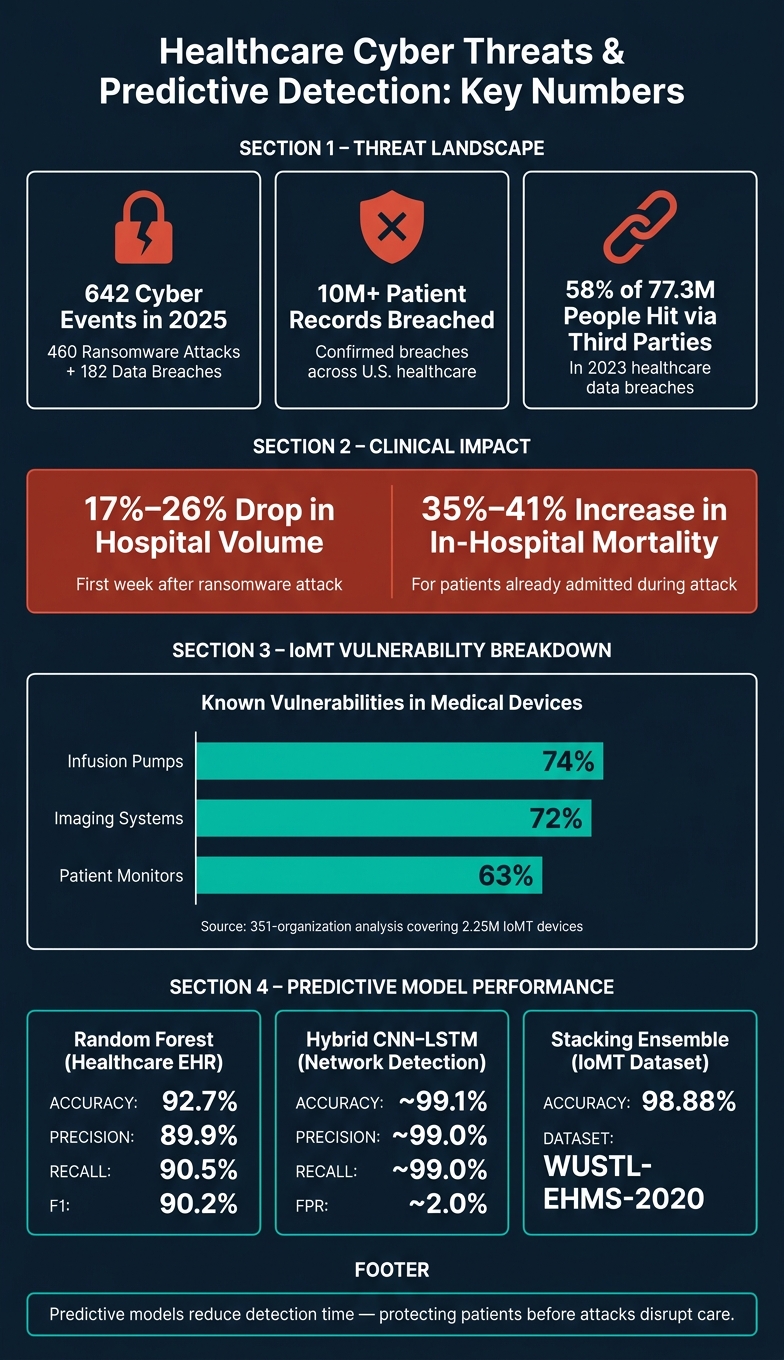
Healthcare Cyber Threat Statistics & Predictive Model Performance 2023–2025
Healthcare AI Has a Cybersecurity Problem
sbb-itb-535baee
Quick comparison
| Area | What the article says |
|---|---|
| Main goal | Find threats earlier and sort risk before care is disrupted |
| Main data inputs | EHR logs, identity logs, network traffic, endpoint data, cloud audit logs, IoMT telemetry, vendor risk data |
| Best model fit | Depends on the use case, labels, and data quality |
| Main model groups | Supervised, unsupervised, sequence-based, hybrid |
| Success metrics | Precision, recall, F1-score, ROC-AUC, false positive rate, time-to-detect |
| Safety check | Human approval for actions that may affect care delivery |
| Governance needs | HIPAA controls, BAAs, audit logs, model register, drift review, adversarial testing |
Bottom line: if I want predictive threat detection to work in healthcare, I need good data, healthcare-specific features, the right model for the job, and tight human and compliance controls from day one.
Healthcare Threat Data and Model Inputs
Predictive models break down when the data feeding them is incomplete, messy, or tagged the wrong way. In healthcare, that problem gets bigger fast because data often lives across dozens of disconnected systems. Getting the inputs right is the first hard part. After that, those raw inputs need to be normalized into healthcare-specific features that a model can actually use.
Key Data Sources Across Hospital IT and Clinical Environments
Predictive detection should pull from network telemetry, EHR and identity logs, endpoint and SIEM data, cloud audit logs, IoMT telemetry, and vendor risk data.
Network telemetry includes firewall logs, NetFlow, DNS queries, VPN activity, and east-west traffic. These signals show connection patterns that can point to lateral movement or data exfiltration. Alongside that, EHR and identity logs from EHR platforms show who accessed which patient records, when they did it, and which device they used. That makes them useful for spotting insider misuse and account takeover.
Endpoint and SIEM data add tagged signals such as malware detections, suspicious processes, and unusual PHI access. As more clinical workloads move into cloud services, cloud audit logs from environments like Microsoft 365 and Azure matter just as much, especially for telehealth platforms and SaaS-based EHRs.
IoMT telemetry needs its own input set. Traffic patterns, protocol behavior, device state, and usage data from infusion pumps, imaging systems, and patient monitors tend to follow repeatable routines. That makes unusual behavior easier to find. A 351-organization analysis covered 2.25 million IoMT devices[3]. Vulnerability data makes the picture worse: 74% of infusion pumps, 72% of imaging systems, and 63% of patient monitors had known vulnerabilities in one sample[4].
Vendor risk data covers a part of the attack surface that technical logs alone miss. In 2023, 58% of the 77.3 million individuals affected by healthcare data breaches were hit through attacks on third-party providers[5]. This data can include security assessments, control maturity scores, PHI scope, and remediation status. Those fields give the model a view across the full healthcare delivery surface. Platforms like Censinet RiskOps™ bring this information together so it can be used next to technical telemetry.
The next job is turning all of these raw events into signals tied to roles, devices, and workflows.
Feature Engineering for Healthcare-Specific Risk
Clinical context is what turns telemetry into risk. Raw logs need to become features that match the way healthcare work happens day to day.
User role and shift-based behavior is one of the strongest inputs. The same access pattern can mean one thing for a night-shift nurse and something very different for a billing contractor at noon. Features like "login outside typical shift hours for this role", "access volume deviation from role baseline", and "new device used for PHI access" help models judge combinations of behavior instead of isolated events. That cuts false positives while still catching real threats. It also helps to train on several months of data so the model sees schedule rotations and seasonal changes before it starts marking behavior as unusual.
Device criticality and PHI sensitivity add weight to the risk signal. A life-sustaining device with an unpatched critical CVE and PHI access carries more risk than the same flaw on a low-impact asset. Patch lag, exploit availability, and data classification level all add detail here. For vendor-connected systems, structured fields from platforms like Censinet RiskOps™ - including control maturity, residual risk, and PHI volume handled - can feed straight into these features.
Workflow and communication path features help catch threats that plain network or identity data can miss. In EHR systems, a view-to-export-to-print sequence from a user with no prior export history is a meaningful change that can point to data misuse before records leave the facility. In PACS or telehealth platforms, unusual API call patterns or access to imaging data outside a user's normal patient population can point to account compromise. For IoMT devices, an infusion pump connecting to an unfamiliar external IP is an abnormal communication path.
Predictive Model Types for Cyber Threat Detection
Once your inputs are ready, the next move is picking the right model family. That choice depends on the threat you're trying to catch, whether you have labels, and how much time and skill your team can put into training and upkeep. In healthcare, this matters even more because the signal may come from user behavior, time-based patterns, or vendor activity.
Supervised, Unsupervised, and Hybrid Approaches
Supervised models learn from labeled benign and malicious events. They work best when you already know what bad activity looks like. In healthcare, that often means incident-tagged EHR activity, phishing data, or VPN logs. Models like Random Forest, XGBoost, and SVM are common picks here. One Random Forest cyber-risk model reached 92.7% accuracy, 89.9% precision, 90.5% recall, and 90.2% F1-score when classifying cybersecurity risk levels in healthcare settings.[2]
Unsupervised models work without labels. Instead of learning “good” and “bad” from past cases, they learn what normal looks like and flag anything that drifts from it. That makes them useful when labels are limited or when attack patterns shift fast. Clustering and autoencoders are often used for this. LSTMs add time awareness, which helps with EHR action sequences and device telemetry. On the CICIoMT2024 dataset, a hybrid autoencoder and LSTM method reached 94.1% accuracy and beat an autoencoder-only baseline.[7][9]
Hybrid approaches combine both styles. A common setup is simple: let an unsupervised model flag odd behavior, then let a supervised model score which alerts are most likely to be real threats. This can cut down on noise without missing too much. A stacking ensemble with Random Forest and SVM as base models reached 98.88% accuracy on the WUSTL-EHMS-2020 healthcare IoMT dataset.[6]
The next step is matching that model family to the environment it needs to watch.
| Model Family | Best Use Case | Data Needs | Interpretability | Deployment Complexity |
|---|---|---|---|---|
| Supervised (Random Forest, XGBoost, SVM) | Known attack classification (EHR access misuse, phishing, VPN abuse) | Large labeled datasets from SIEMs, EHR logs, incident tickets | High - feature importance is auditable | Moderate |
| Unsupervised (Clustering, Autoencoders, Isolation Forest) | Zero-day threats, IoMT baselining, rare-event detection | Unlabeled telemetry streams | Lower - harder to explain to auditors | Low to moderate |
| Sequence-based (LSTM) | Multi-step intrusions, temporal EHR anomalies, API sequence monitoring | Time-synchronized logs, significant compute | Low - outputs require translation for compliance teams | High |
| Hybrid / Ensemble | Broad coverage with reduced false positives | Mix of labeled and unlabeled data | Varies by component | High |
Matching Models to Hospital, Telehealth, and IoMT Scenarios
Model choice shifts with the data source, how much visibility you have, and how fast the team needs to respond.
In high-volume SOC monitoring across large hospital networks, Random Forest and XGBoost are often a good fit. They can handle scale and give outputs analysts can review and act on without much delay.
For IoMT and medical device baselining, unsupervised models are often the more practical option. Many regulated medical devices can't run endpoint agents, so you have to watch them from the outside. The upside is that these devices tend to behave in repeatable ways, which makes autoencoders and clustering useful for spotting drift. In the SHIELD framework for healthcare IoT, XGBoost reached 99% accuracy for faulty device anomaly detection with 0.04 seconds of latency, while Isolation Forest balanced precision and recall for attack detection.[1][8]
Vendor risk is another strong use case for predictive scoring. This is critical as the economic impact of third-party risk continues to grow for healthcare providers. For third-party exposure scoring, Random Forest and XGBoost work well with mixed inputs like questionnaires, integration depth, PHI volume, and incident history. Censinet RiskOps™ can combine those inputs to score vendor risk and help teams decide what to review first.
For alert prioritization, supervised models trained on SOC triage outcomes can rank alerts by likely patient impact.
Evaluating, Deploying, and Governing Predictive Models
Performance Metrics That Matter in Healthcare
Choosing a model is only half the work. The other half is showing that it performs well in a healthcare setting.
In U.S. healthcare, six metrics show up again and again in cyberattack detection testing: accuracy, precision, recall, F1-score, ROC-AUC, and time-to-detect.[8] Each one points to a different kind of operational risk.
| Metric | What It Measures | Why It Matters in Healthcare |
|---|---|---|
| Precision | Of all alerts fired, how many are real threats | Low precision creates alert fatigue and wastes analyst time |
| Recall (TPR) | Of all real attacks, how many the model catches | Low recall can mean missed ransomware, EHR downtime, and patient diversion |
| F1-Score | Balance between precision and recall | Helps teams tune thresholds without leaning too far in either direction |
| ROC-AUC | How well the model separates benign from malicious activity across thresholds | Helps CISOs pick an operating point that matches their risk tolerance |
| False Positive Rate (FPR) | How often benign events get flagged as threats | High FPR wears down analyst trust and adds cognitive load |
| Time-to-Detect | Time from initial compromise to model alert | Shorter times can cut care disruption, appointment cancellations, and delays in critical procedures |
Results differ by model and dataset. One hybrid CNN–LSTM model for healthcare network cyberattack detection reached about 99.1% accuracy, about 99.0% precision and recall, and a false positive rate of about 2.0% - the lowest among the architectures compared in that study.[10] Another healthcare cybersecurity framework reported 97.92% accuracy with 90% precision, 90% recall, and a ROC-AUC of 0.94.[11]
Security operations researchers also suggest tracking Alert Queue Reduction Rate at a fixed false negative rate, such as FNR ≤ 2%, along with Mean Time to Detect and Mean Time to Respond.[14] That matters because these metrics tie model output to SOC capacity and patient-care timing.
At the end of the day, the model has to help analysts make better calls without burying them in noise.
Deployment Architecture and Human Oversight
Once a model passes validation, it still has to work inside the SOC.
A model that sits outside the workflow doesn’t do much good. Deployment means feeding model output into the tools analysts already use, especially SIEM and SOAR platforms, so alerts land in normal queues with added context such as asset criticality, data sensitivity, and patient-safety impact.
Logs from EHR systems, identity providers, medical devices, and network sensors should move into a secure central environment with strict access controls and encryption. During feature extraction, PHI exposure should stay as limited as possible by leaning on behavioral and technical signals, like login patterns and device communication graphs, instead of patient identifiers. If identifiers can’t be avoided, use de-identification or tokenization in line with HIPAA’s minimum necessary standard.
Model drift is a real operational problem. MLOps research found that a 6.4% drop in AUC-ROC - from 0.847 to 0.793 - was enough to cross a preset alert threshold and trigger review.[13] Sustained drops in F1-score, spikes in FPR, or a rise in missed critical incidents can all point to slower detection and more clinical risk. Big IT changes, like EHR upgrades, new telehealth platforms, or shifts in attacker behavior, are also clear retraining triggers. Version models carefully, keep earlier versions available, and set rollback criteria before anything goes live in production.
For automated containment, patient-safety tiers should decide what the system can do on its own and what needs human approval. A non-clinical workstation can be isolated automatically. Blocking a clinician’s account or quarantining a medication dispensing system should require SOC sign-off. Taking a direct patient-care device offline should need joint approval from security and clinical leadership, with safety concerns written down. If a model flags anomalous traffic from an infusion pump network, for example, the system might automatically quarantine non-critical test devices while sending production-device decisions to clinical oversight.
U.S. Governance, Privacy, and Risk Management Alignment
After deployment, governance is what keeps the model auditable, stable, and safe.
The HIPAA Security Rule sets the baseline. It requires administrative, physical, and technical safeguards for electronic PHI (ePHI), and those rules apply directly to how predictive models are built, trained, and run. Training data should limit identifiable PHI where possible. Inference services need encryption in transit and at rest, role-based access control, and audit logs that show who queried the model and what actions followed. Business Associate Agreements (BAAs) are required when outside vendors or cloud services take part in processing that data.[12][15]
Keep a model register that records each model’s purpose, data sources, training method, validation results, and deployment context. Audit logs should record inputs, outputs, thresholds, and response actions. That supports both forensic work and regulatory review. Periodic independent reviews should also check for bias, blind spots, and fit with the documented risk management framework.
Adversarial ML risks need direct attention in healthcare. Attackers can shape inputs to dodge detection or poison training data. That’s a serious issue when a compromised model could help hide attacks on clinical systems. Common controls include:
- Data validation and provenance checks
- Bias assessments across facilities and user roles
- Interpretable models or explainability methods
- Adversarial testing that simulates evasion attempts
NIST guidance on trustworthy and resilient AI gives teams a practical frame for setting up these controls.
Detection signals can also strengthen third-party and enterprise risk reviews. Anomalous vendor access patterns, unusual data flows from a telehealth integration, or elevated risk scores for certain assets give those assessments a basis in observed behavior, not just questionnaire answers.
Conclusion: Building a Practical Predictive Detection Strategy
Healthcare is still a common target in the U.S., and predictive models give security teams a way to act before an attack disrupts care. That matters because the best results come from healthcare-specific signals, not generic IT telemetry.
Predictive detection moves teams beyond waiting for confirmed incidents. Instead, it helps them spot early warning signs across EHR, network, device, and vendor data. Clinical workflows, on-call access patterns, IoMT device behavior, and third-party dependencies all need to be part of that view. Once those signals are in place, choosing a model becomes a practical tradeoff, not a theory exercise.
Model choice should match the use case. Supervised models fit known attack patterns when labeled data exists. Unsupervised methods make more sense for surfacing new anomalies. Hybrid approaches can balance both, especially when threats shift fast or labeled data is hard to get. The key is to match the model to the risk environment and the team’s tolerance for errors. A model only matters if analysts can use its output inside the workflows they already rely on.
Deployment without governance just pushes risk into a different corner. Predictive outputs should flow into existing SOC workflows, with clear escalation paths, documented risk appetite, and human review for any action that could affect clinical operations or device availability. Platforms like Censinet RiskOps™ can help organize third-party and enterprise risk assessments, support remediation, and line up predictive detection with HIPAA and NIST-based controls.
When this is done right, detection supports care instead of getting in the way. The aim is simple: spot real threats earlier, keep false positives under control, and protect patient safety and continuity of care.
FAQs
How do predictive models reduce ransomware risk in hospitals?
Predictive models cut ransomware risk by learning what normal looks like across EHR access, network traffic, and endpoint behavior. Once those patterns are clear, the models can flag unusual activity that may show up hours or even days before an attack is deployed.
They also help teams decide what to fix first. By spotting which vulnerabilities, vendors, or assets are most likely to be targeted, these models make it easier to isolate and contain threats faster, which can help protect critical systems like EHRs.
What data is needed to train healthcare threat detection models?
Healthcare threat detection models need clean, standardized data pulled from several sources, such as:
- EHR logs
- IoMT device telemetry
- Network activity logs
- Identity and access management data
- Cloud-platform logs
They also need historical incident data, baselines for normal activity, and day-to-day context, like user roles and how sensitive each device is.
When should hospitals use supervised vs. unsupervised models?
Use supervised learning when you have labeled historical data, like records of past breaches or malware incidents, and the goal is to classify known attack patterns.
Use unsupervised models when labeled data is scarce or when teams need to spot new threats, like zero-day exploits or insider threats. These models set a baseline for normal behavior and flag anything that drifts from it. Many healthcare organizations use a hybrid approach to cover both.
