
Phishing is a major cybersecurity threat in healthcare, with over 90% of cyber-attacks starting from phishing emails. In 2025 alone, phishing-related breaches exposed hundreds of thousands of patient records and cost organizations millions of dollars. Attackers use tactics like AI-generated messages, brand impersonation, and QR code scams to exploit vulnerabilities. Here's a quick breakdown of the top phishing risks healthcare organizations face:
Key takeaway: Healthcare organizations must strengthen defenses with multi-factor authentication, advanced email security tools, and staff training to combat these evolving threats. Solutions like DMARC enforcement and phishing simulations can significantly reduce risks.
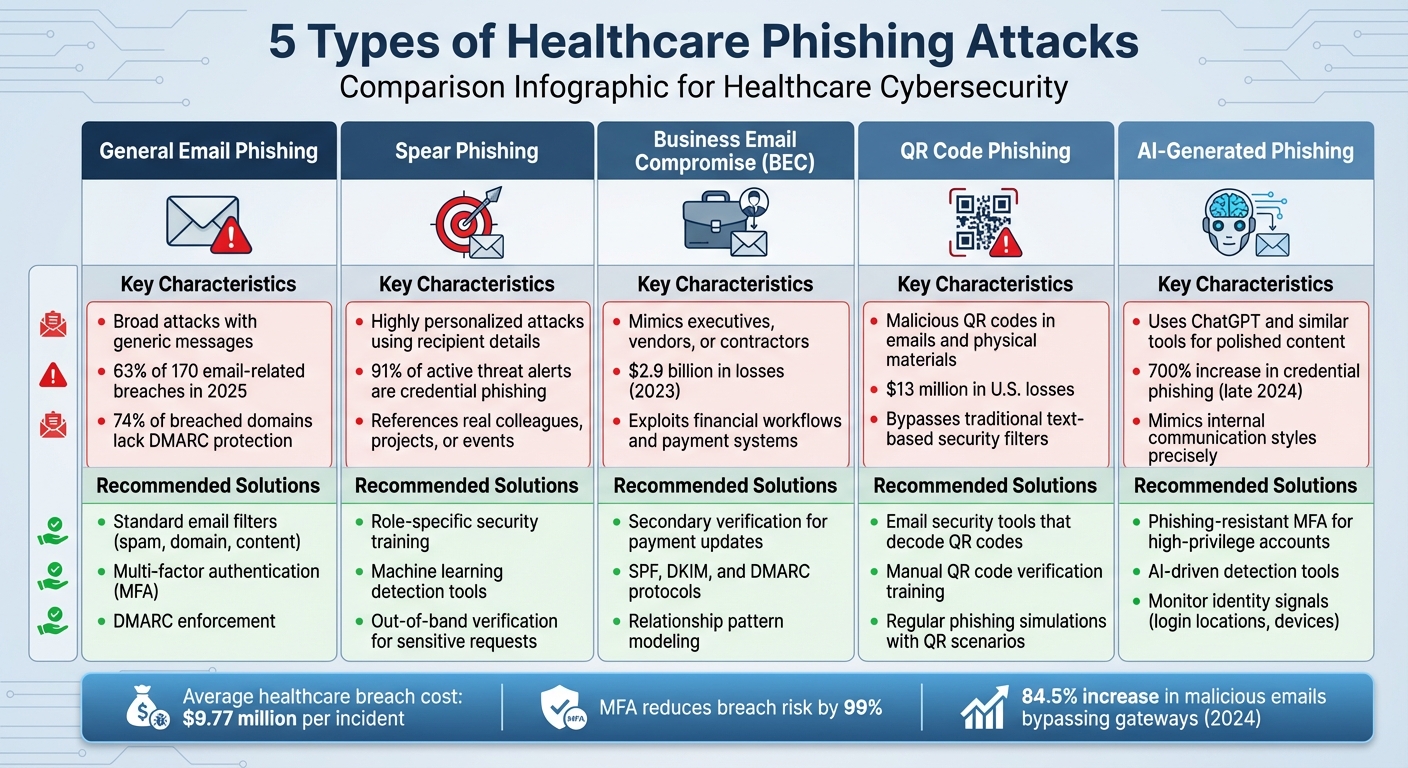
5 Types of Healthcare Phishing Attacks: Characteristics and Defense Strategies
Phishing Training for Healthcare Workers - HIPAA Certify
sbb-itb-535baee
1. General Email Phishing
General email phishing is the starting point for understanding more advanced phishing tactics and remains the most common method attackers use in healthcare cybersecurity.
How Common Is General Phishing?
General email phishing continues to dominate as the main entryway for healthcare cyberattacks. In 2025, it accounted for 63% of the 170 email-related breaches reported [2][8]. The problem has grown worse, with breaches on Microsoft 365 rising to 53% in 2025, compared to 43% in 2024 [2]. One major weakness? A staggering 74% of affected domains lacked proper DMARC protection, making it easy for attackers to spoof trusted email addresses [2].
The Toll on Healthcare Organizations
The widespread nature of phishing attacks has a ripple effect on healthcare operations. In 2025, mailbox takeovers caused by phishing made up 17% of email-related breaches but exposed over 630,000 patient records [2][3]. Once attackers gain access through stolen credentials, they can log in undetected and sift through historical emails for sensitive patient health information (PHI) [3]. To make matters worse, attackers often use high-pressure tactics, like fake IT alerts or supplier requests, to trick users into clicking malicious links [4]. These schemes have also evolved to exploit trusted platforms, such as direct secure messaging systems and Google-hosted services, making it even harder to spot identity abuse [3].
Financial and Data Breach Risks
The financial fallout from phishing-related breaches is staggering. On average, these incidents cost $7.4 million each. Breaches involving third-party vendor risk are slightly less costly at $4.9 million but can impact multiple organizations when vendor credentials are compromised [3]. The overall risk environment worsened in 2025, with 41% of healthcare organizations categorized as high risk, up from 31% in 2024 [2].
How to Fight Back Against Phishing
Given the financial stakes, effective defenses are a must. However, traditional approaches like user awareness training often fall short once credentials are stolen [3]. To stay ahead, organizations need to adopt email-layer security that blocks phishing attempts before they reach inboxes [3]. Strengthening DMARC enforcement is also critical, yet it's missing in most organizations that experience breaches [2]. Verification protocols for unusual requests - especially those mimicking IT alerts or supplier communications - can significantly reduce risks [4][5]. Even so, the doubling of email breaches despite existing tools highlights the need for continuous monitoring and stronger identity controls to complement basic email protections [7]. These strategies lay the groundwork for tackling more targeted phishing attacks, which will be explored next.
2. Spear Phishing
Prevalence of the Phishing Type
Spear phishing is a major concern in healthcare because of its highly targeted nature. Suspicious activity accounts for between 2% and 3% of all email and internet traffic in this sector, with healthcare organizations facing over 50 million potentially harmful transactions every year [1]. Alarmingly, 91% of active threat alerts in healthcare are related to credential phishing [1].
Impact on Healthcare Organizations
What makes spear phishing particularly dangerous is its focus on specific individuals or departments. Unlike general phishing, which relies on sending generic emails to a large audience, spear phishing involves highly personalized messages. Attackers often research their targets thoroughly, referencing real colleagues, projects, or events to make their communications seem authentic. This tailored approach exploits the trust inherent in healthcare communications. Adding to the challenge, cybercriminals now use AI to create lifelike profile photos, forged IDs, and even deepfakes, making these attacks nearly impossible to distinguish from legitimate interactions.
Potential for Data Breaches or Financial Loss
The consequences of a successful spear phishing attack in healthcare can be devastating. Medical records, which hold far more value on the black market than credit card information, are prime targets. Once attackers gain access through compromised credentials, they can infiltrate systems housing sensitive patient data. With healthcare's increasing reliance on digital records, human error remains a significant vulnerability. Cybercriminals are also leveraging AI to craft error-free, convincing messages that easily bypass traditional fraud detection systems [1].
Effectiveness of Mitigation Strategies
To counter these advanced threats, healthcare organizations must adopt strong defensive measures. According to Microsoft, using multi-factor authentication (MFA) can reduce the likelihood of a breach by 99% [1]. This ensures that even if credentials are compromised, attackers cannot gain access. A multi-layered email security system is also critical. Combining spam filters, content filters, domain filters, and machine learning tools can help identify and block sophisticated phishing attempts. Regular phishing simulations are another effective strategy, allowing staff to practice spotting and reporting targeted attacks in a safe environment [1].
3. Business Email Compromise (BEC)
Prevalence of the Phishing Type
Business Email Compromise (BEC) is a major threat to healthcare organizations, carrying both financial and reputational risks. According to the FBI's 2023 Internet Crime Report, BEC accounted for $2.9 billion in reported losses from 21,489 complaints [9]. Between October 2013 and December 2022, the Health Sector Cybersecurity Coordination Center (HC3) documented over $50.8 billion in losses from BEC attacks specifically targeting healthcare [9]. While the number of reported incidents slightly dipped in 2023, the financial damage continues to rise. This trend suggests attackers are refining their techniques, making BEC an evolving challenge that demands specialized defenses.
Impact on Healthcare Organizations
BEC attacks exploit trust and familiarity, often using social engineering and compromised email accounts to deceive. Attackers typically pose as trusted figures - such as executives, legal advisors, or vendors - to manipulate organizations into transferring funds or sharing sensitive information. Healthcare is especially vulnerable due to its intricate payment systems, reliance on numerous third-party vendor relationships, and a workforce focused on patient care rather than fraud detection.
For instance, in February 2025, a medical center narrowly avoided losing $500,000 worth of prescription drugs after attackers compromised its DEA ID and pharmaceutical certificates [9]. In another case, criminals targeted a children's hospital by monitoring public announcements about a construction project. They used spoofed domains to impersonate the construction company's CFO, successfully redirecting payments for the project to fraudulent accounts [9].
Potential for Data Breaches or Financial Loss
Beyond financial fraud, BEC attacks can lead to unauthorized access to sensitive patient records and regulatory credentials. Attackers often use cryptocurrency and third-party payment platforms to quickly move stolen funds. Additionally, healthcare's supply chain is a frequent target. Criminals may impersonate medical equipment suppliers or service providers to reroute payments or obtain prescription drugs and construction funds fraudulently.
Effectiveness of Mitigation Strategies
Defending against BEC requires a multi-layered approach. Implementing email authentication protocols like SPF, DKIM, and DMARC can help prevent domain spoofing. Multi-step verification processes, such as confirming vendor payment changes through verified phone calls, are crucial for safeguarding large transactions. Regular access management reviews ensure that employees only have the permissions necessary for their roles, reducing the risk of misuse or exploitation.
Training staff to recognize and challenge suspicious requests - especially those that come with a sense of urgency or authority - is equally important. Employees should feel confident verifying unusual communications, even if they appear to come from high-ranking executives [9].
Healthcare organizations can also benefit from platforms like Censinet RiskOps™ (https://censinet.com), which streamline risk assessments and enhance third-party risk management. Up next, we’ll explore emerging threats like QR Code Phishing.
4. QR Code Phishing
How Common Is This Threat?
QR code phishing, also known as "quishing", is becoming a go-to method for attackers because it can slip past both human awareness and technical defenses. Standard email security systems often don’t decode or analyze QR codes, especially when they’re embedded as images rather than clickable links [10]. This has led to significant financial damage - QR code scams in the U.S. alone have caused $13 million in losses [11]. Beyond digital attacks, criminals place malicious QR codes on physical items like posters, flyers, and stickers, even targeting spaces like healthcare facilities [10].
Why Healthcare Organizations Are at Risk
Healthcare workflows are a prime target for quishing attacks. Malicious QR codes are often disguised in invoices, shipping updates, or account verification prompts, with attackers pretending to represent trusted brands like Microsoft [10]. Some phishing emails use branded images containing embedded QR codes, making them harder to detect through traditional security tools [10]. The Health Sector Cybersecurity Coordination Center (HC3) warns that these attacks could serve as gateways for severe cyberattacks on healthcare organizations [11]. Common tricks include fake requests to update COVID-19 vaccination details, verify insurance information, access patient test results, or review updated medical procedures [11].
Risks of Data Breaches and Financial Damage
QR codes are inherently deceptive because they hide the URLs they lead to, removing a key safety cue for users. When healthcare workers scan these codes, the attack often shifts from secure corporate systems to personal mobile devices, which may not have the same level of security monitoring [10]. These malicious codes can steal login credentials, capture multi-factor authentication tokens, or direct users to malware-infected sites [10]. Unfortunately, curiosity often drives people to scan unknown QR codes, making this attack method especially effective [11]. On the bright side, machine learning tools have shown promise in detecting harmful QR codes, with accuracy rates as high as 96.47% [11].
How to Defend Against Quishing
Protecting against QR code phishing requires targeted strategies. Healthcare organizations should use email security tools capable of decoding QR codes to check their destinations, assess reputations, and analyze redirects [10]. Adding warning banners can discourage staff from scanning external QR codes impulsively [10]. Phishing simulations focused on QR-based lures, such as fake account verifications or invoice prompts, are an excellent way to train employees to spot these scams [10]. Strict policies are also essential - staff should avoid scanning QR codes from unverified sources, especially those demanding immediate action [11]. Regular physical inspections of QR codes in shared spaces, like break rooms or on medical devices, can help detect tampering or unauthorized overlays [11].
For a more robust defense, healthcare organizations can adopt risk management platforms like Censinet's RiskOps™, which simplifies risk assessments and strengthens cybersecurity strategies tailored to the healthcare sector.
Next, we’ll dive into Section 5 to see how AI is making phishing attacks even more sophisticated.
5. AI-Generated Phishing
Prevalence of the Phishing Type
Phishing tactics have taken a sharp turn with the rise of artificial intelligence. Tools like ChatGPT and Google Gemini make it easier than ever for attackers to churn out polished phishing content - no advanced skills required. The result? A staggering 700% increase in credential phishing incidents in late 2024 [12]. This surge is directly tied to generative AI tools, which allow attackers to scale operations like never before. They can tweak tone, formatting, and phrasing on the fly, bypassing security filters and fooling employees with alarming ease. This shift has created a whole new level of risk, particularly for healthcare organizations.
Impact on Healthcare Organizations
Healthcare systems are especially vulnerable to AI-generated phishing. Their sprawling workforces and extensive vendor networks give attackers plenty of opportunities to craft convincing credential requests. Errol Weiss, Chief Security Officer at Health-ISAC, explains the growing threat:
"AI allows attackers to mimic internal IT alerts, HR messages or patient care requests with precision, often using real staff names, logos and organizational language pulled from public sources."
These attacks are designed to steal credentials, allowing hackers to impersonate legitimate users. Traditional firewalls struggle to counter this type of threat. Weiss highlights the core issue:
"The real target in most cyberattacks isn't the system, it's the person logging in."
Once credentials are compromised, it’s not just about stolen data - it’s about opening the door to a series of vulnerabilities across the organization.
Potential for Data Breaches or Financial Loss
AI-generated phishing doesn’t just threaten finances; it puts clinical operations and patient safety at risk. With stolen credentials, attackers gain access to critical systems like Electronic Health Record (EHR) platforms, financial systems, and remote admin tools. This can lead to system outages, unauthorized access to sensitive medical records, and disruptions in patient care. Since attackers can operate under the guise of legitimate users, these breaches often go unnoticed until significant damage is done.
Effectiveness of Mitigation Strategies
Fighting back against AI-generated phishing requires an identity-first approach to security. Here’s how organizations can strengthen their defenses:
Training is another critical piece. Incorporate real-world phishing examples - anonymized but relevant - into clinical workflows to make the threat tangible for staff.
One solution to streamline these efforts is Censinet RiskOps™ (https://censinet.com), which simplifies risk assessments while supporting identity-first security measures.
Comparison Table
Phishing risks come in different forms, each requiring specific strategies to address them effectively. By understanding the nuances of these threats, healthcare organizations can allocate resources wisely and build a multi-layered defense system. Below is a breakdown of five common phishing types, their characteristics, and suggested countermeasures.
Broad attacks with generic messages; often includes basic links or attachments, focusing on volume over precision.
Use standard email filters (spam, domain, content) alongside multifactor authentication (MFA) to thwart unauthorized access, even if credentials are compromised.
Tailored attacks using personal details about the recipient; often references colleagues, projects, or events to build credibility.
Provide role-specific security training with realistic scenarios. Deploy machine learning tools to detect unusual behavior and implement out-of-band verification for sensitive requests.
Mimics executives, vendors, or contractors; often exploits organizational complexities and financial workflows like payment instructions.
Require secondary verification for payment updates, use relationship pattern modeling, and monitor behaviors to detect impersonation attempts.
Embeds malicious QR codes in emails to bypass traditional text-based security filters.
Train employees to manually verify QR codes and conduct regular simulations to improve recognition and reporting of suspicious mobile activities.
Leverages generative AI to create polished, authentic-looking messages that mimic internal communication styles and evade detection.
Use phishing-resistant MFA for high-privilege accounts, AI-driven detection tools, and monitor identity signals like unusual login locations or device changes.
These differences highlight the need for customized email security policies for each threat.
"Understanding what normal behaviors are - if I'm always logging in from Texas, always calling Matt 'Matt,' and all of a sudden I'm calling Matt 'Matthew' and logging in from Hong Kong, well, there's obviously some signals there"
.
Mike Britton, CIO at Abnormal AI, emphasizes the value of monitoring behavioral patterns to identify potential threats.
The healthcare sector remains the most expensive industry for breach costs, averaging $9.77 million per incident - a title it has held for over a decade [13]. Alarmingly, malicious emails bypassing secure email gateways rose by 84.5% in 2024 [1]. Even basic measures like phishing-resistant MFA can reduce breach risks by 99% [1], proving their importance.
For healthcare organizations seeking to strengthen their defenses, solutions like Censinet RiskOps™ provide tailored tools to address the unique challenges of the industry.
This comparison underscores the critical role of targeted, layered defenses in mitigating phishing risks effectively.
Conclusion
Phishing threats, ranging from generic attempts to sophisticated AI-generated schemes, highlight the pressing need for a robust email security strategy. These attacks are the most expensive threat to healthcare email systems, with the average cost of a breach reaching $7.4 million per incident in 2025 - a figure that has more than doubled in recent years [3][7]. Email security can no longer be treated as an afterthought.
To address these risks, healthcare organizations must adopt layered defenses. While employee training is important, the fast-paced healthcare environment requires solutions that intercept phishing attempts before they reach inboxes [4]. This means implementing email-layer security capable of detecting and blocking phishing, impersonation, and spoofed identities at the source [3]. Shockingly, 74% of breached domains in 2025 lacked proper DMARC protection, showing that even basic technical measures are often overlooked [2].
Advanced threat detection is another critical layer. Attackers are increasingly abusing trusted platforms and leveraging AI to craft phishing emails that evade traditional defenses [3][6]. Once credentials are compromised, conventional security measures often fail to identify account takeovers, leaving organizations vulnerable to further damage [3].
Solutions like Censinet RiskOps™ (https://censinet.com) offer targeted protection by managing cybersecurity risks across both internal systems and third-party vendor risk management. This is especially crucial since nearly one-third of email-related incidents involve vendor or business associate exposure [3]. To safeguard patient data in an ever-evolving threat landscape, healthcare organizations must treat email security as essential infrastructure. This involves updating policies, enforcing DMARC, and combining realistic training with advanced technical controls to defend against phishing threats effectively.
FAQs
What’s the fastest way to tell if an email is a phishing attempt in a hospital setting?
Phishing emails can be a real headache, especially in a hospital setting where sensitive information is at stake. To spot one quickly, hover over any links to see where they actually lead - this can reveal suspicious or mismatched URLs. Keep an eye out for red flags, like strange sender addresses or emails that demand urgent action. These tactics are often used to pressure you into making a mistake.
When in doubt, double-check any requests through trusted channels - whether that’s a direct call to the supposed sender or consulting your IT department. Staying alert and following your hospital’s security protocols can go a long way in keeping everyone safe.
Which accounts should get phishing-resistant MFA first?
Phishing-resistant MFA should be prioritized for accounts with privileged or administrative access to critical systems like cloud management consoles, electronic health records (EHRs), and databases. It’s equally important to apply it to secure workforce access to internal tools, including email and web applications, as well as third-party or vendor access to systems that manage electronic protected health information (ePHI).
How can we reduce third-party and vendor email phishing risk?
Healthcare organizations can better protect themselves from phishing attacks by blending technical defenses with effective staff training. Here’s how:
Adding regular phishing simulations to your training program can help employees stay alert. Combine this with a solid incident response plan to reduce vulnerabilities and tighten email security.
Related Blog Posts
- Checklist for Identifying Phishing Emails in Healthcare
- How to Secure Email Gateways in Healthcare
- AI-Enhanced Phishing: The Evolution of Social Engineering Attacks
- AI in Phishing Response: Healthcare Use Cases
{"@context":"https://schema.org","@type":"FAQPage","mainEntity":[{"@type":"Question","name":"What’s the fastest way to tell if an email is a phishing attempt in a hospital setting?","acceptedAnswer":{"@type":"Answer","text":"<p>Phishing emails can be a real headache, especially in a hospital setting where sensitive information is at stake. To spot one quickly, <strong>hover over any links</strong> to see where they actually lead - this can reveal suspicious or mismatched URLs. Keep an eye out for <strong>red flags</strong>, like strange sender addresses or emails that demand urgent action. These tactics are often used to pressure you into making a mistake.</p> <p>When in doubt, <strong>double-check any requests through trusted channels</strong> - whether that’s a direct call to the supposed sender or consulting your IT department. Staying alert and following your hospital’s security protocols can go a long way in keeping everyone safe.</p>"}},{"@type":"Question","name":"Which accounts should get phishing-resistant MFA first?","acceptedAnswer":{"@type":"Answer","text":"<p>Phishing-resistant MFA should be prioritized for accounts with <strong>privileged or administrative access</strong> to critical systems like cloud management consoles, electronic health records (EHRs), and databases. It’s equally important to apply it to secure <strong>workforce access</strong> to internal tools, including email and web applications, as well as <strong>third-party or vendor access</strong> to systems that manage electronic protected health information (ePHI).</p>"}},{"@type":"Question","name":"How can we reduce third-party and vendor email phishing risk?","acceptedAnswer":{"@type":"Answer","text":"<p>Healthcare organizations can better protect themselves from phishing attacks by blending technical defenses with effective staff training. Here’s how:</p> <ul> <li><strong>Implement secure email protocols</strong>: Use tools like encryption, data loss prevention (DLP), and multi-factor authentication (MFA) to safeguard sensitive communications.</li> <li><strong>Train employees</strong>: Teach staff how to spot phishing attempts, verify requests through trusted channels, and steer clear of suspicious links or attachments.</li> </ul> <p>Adding regular phishing simulations to your training program can help employees stay alert. Combine this with a solid incident response plan to reduce vulnerabilities and tighten email security.</p>"}}]}
