
Healthcare CISOs are stepping into a new role: managing AI governance alongside cybersecurity. With AI risks surpassing traditional concerns, like vulnerability management, only 25% of organizations have frameworks in place, leaving patient data at risk. By 2026, 90% of organizations will use autonomous AI, making governance a critical priority.
Key takeaways:
To lead AI governance effectively, CISOs must create structured frameworks, form governance committees, and adopt tools like Censinet RiskOps™ for risk assessments and real-time monitoring. These steps balance innovation with patient safety while ensuring compliance with regulations like HIPAA and NIST standards.
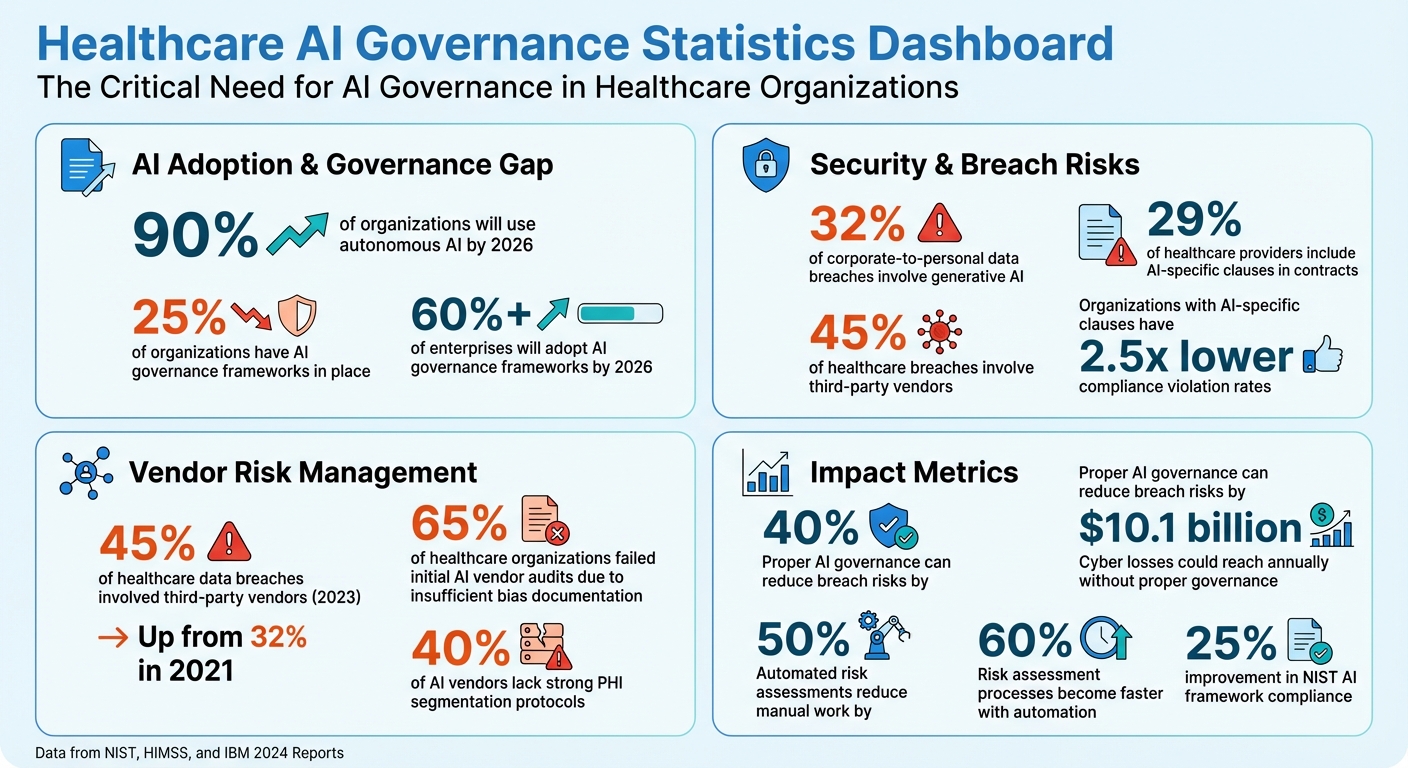
AI Governance in Healthcare: Key Statistics and Risk Metrics for CISOs
Healthcare AI Governance - Risks, Compliance, and Frameworks Explained
sbb-itb-535baee
The AI Governance Landscape in Healthcare
Healthcare CISOs are now facing a growing need to comply with regulations that demand robust AI governance. By 2026, more than 60% of enterprises are expected to implement formal AI governance frameworks to address increasing security, risk, and compliance challenges [1]. This shift reflects the reality that AI systems in healthcare impact everything from diagnostic tools to patient scheduling, introducing vulnerabilities that traditional risk management strategies can't fully address. As a result, CISOs must rethink their approaches to managing these emerging risks.
AI governance requires input from multiple areas of expertise. CISOs must work alongside legal teams to ensure compliance, collaborate with data scientists to secure AI models, and coordinate with clinical leaders to prioritize patient safety. This cross-functional effort is critical to navigating both the technical and clinical complexities of AI systems. David Forman, Founder of Mastermind Assurance, highlights this need for clarity in roles and responsibilities:
"The first step in establishing an AI governance program is figuring out who is responsible for what actions. This might include top management sponsors, compliance program managers, regulatory and legal compliance advisors, risk owners, as well as technical SMEs"
.
As the role of CISOs evolves, they are increasingly leading Trusted AI initiatives by bridging technical insights with clinical priorities. In some cases, organizations are appointing CISOs as Chief AI Officers or integrating them more closely with data science teams. This shift reflects a growing recognition that AI security must be embedded throughout the system lifecycle, not added as an afterthought.
Key Regulations and Standards for Healthcare AI
Healthcare organizations must align their AI efforts with established frameworks that address both cybersecurity and AI-specific risks. The NIST AI Risk Management Framework (RMF) provides a structured approach to identifying, assessing, and mitigating AI-related risks throughout the lifecycle of these systems. Many organizations are now aligning their internal governance policies with this framework, as well as standards like ISO 42001.
At the same time, HIPAA compliance remains a cornerstone for any AI system that handles protected health information (PHI). These systems must meet stringent security and privacy requirements, including encryption, access controls, audit logging, and breach notification protocols tailored to AI use cases.
The NIST Cybersecurity Framework (CSF) also offers valuable guidance for integrating AI security into broader risk management strategies. Its five core functions - Identify, Protect, Detect, Respond, and Recover - can help CISOs develop comprehensive AI governance programs. However, adapting these frameworks to address AI-specific challenges, such as model drift, requires a nuanced approach that goes beyond traditional software vulnerabilities.
Beyond regulatory compliance, ethical considerations are increasingly shaping how AI is deployed in healthcare.
Ethical AI in Healthcare: Balancing Progress with Responsibility
Ethical challenges in healthcare AI extend well beyond meeting regulatory requirements. One major concern is bias in AI models, which can directly impact patient safety and health equity. AI tools trained on datasets that fail to represent diverse populations may deliver less accurate results for underrepresented groups. To address this, CISOs must work closely with clinical and data science teams to evaluate data sources and monitor model outputs for potential bias.
Another critical aspect is transparency and explainability. Healthcare providers need to understand how AI systems generate their conclusions, especially when these decisions influence patient care. Policies requiring human oversight of automated decisions that significantly affect treatment outcomes can help strike a balance between efficiency and accountability.
Patient consent and data protection are also central to ethical AI use. Implementing Privacy by Design principles involves building strong data protection measures into AI systems from the beginning. This includes minimizing the collection of sensitive data, enforcing rigorous data hygiene practices, and ensuring patients are fully informed about how their data will be used. Additionally, CISOs must tackle the risk of employees unintentionally exposing patient information by inputting sensitive data into public large language models (LLMs). Addressing this issue requires a combination of targeted training and technical safeguards.
As Sravish Sridhar, CEO of TrustCloud, puts it:
"The challenge is implementing an AI governance framework that allows your business to innovate confidently while minimizing risks"
.
Ultimately, healthcare CISOs must design governance structures that not only support clinical advancements but also uphold the trust patients place in their care providers. This responsibility lies at the heart of their role in shaping the future of AI in healthcare.
Building an AI Governance Framework
Creating an AI governance framework involves more than simply meeting regulatory requirements. CISOs need a structured strategy that spans the entire AI system lifecycle. This framework should align with ethical standards and regulations, such as HIPAA and FDA guidelines for medical devices. It should also focus on identifying risks like biases or potential failure points in AI models, and ensure transparency through explainable AI techniques used in clinical decision-making. Once the AI systems are operational, continuous monitoring becomes essential. Real-time tracking can catch issues like accuracy drift before they affect patient care. Additionally, having a well-defined team structure avoids disorganized deployments and supports scalable processes. This structured approach allows CISOs to guide AI initiatives effectively, integrating technical, regulatory, and clinical priorities.
Core Components of an AI Governance Framework
A strong framework starts with thorough documentation. Every AI algorithm should come with detailed records covering data sources, decision-making logic, and interpretability methods. Automated dashboards are vital for tracking metrics like accuracy drift and fairness scores, ensuring consistent performance. Lifecycle management is another key element, outlining every stage from initial concept to post-deployment evaluations. Clearly defined roles help avoid missteps; for instance, the CISO might focus on technical implementation while compliance teams handle regulatory oversight. To complement these technical aspects, a cross-functional committee ensures the framework addresses all ethical, clinical, and regulatory considerations.
Creating Cross-Functional AI Governance Committees
Technical measures alone aren't enough - cross-functional oversight is crucial for well-rounded governance. AI governance shouldn't be confined to a single department. Instead, committees made up of IT experts, compliance officers, clinicians, legal advisors, and ethics specialists can tackle the technical, regulatory, clinical, and safety aspects of AI systems. To set up such a committee, organizations should draft a charter that defines its goals (such as reviewing high-risk AI implementations), secure executive backing, and gather key stakeholders. Assigning clear responsibilities and holding regular, agenda-driven meetings ensures the committee stays focused. Documented decision-making processes - whether by consensus or voting - along with collaborative tools to track progress, help maintain consistent oversight. These committees enable CISOs to coordinate governance efforts that balance innovation with security.
AI Use Case Inventories and Risk Assessment Tools
A centralized inventory of all AI use cases is essential for managing risks effectively. This inventory should include key details for each deployment, such as its purpose (e.g., predictive analytics for patient readmissions), data sources, risk level (low, medium, or high), assigned owner, current status (development or live), and compliance status. This comprehensive overview allows CISOs to identify gaps and prioritize risk assessments. Integrating this inventory with risk assessment tools enhances oversight. For example, platforms like Censinet RiskOps™ streamline this process by automating inventory management, risk scoring, and real-time dashboards that flag issues like HIPAA non-compliance or model drift. These tools also assign responsibility for resolving flagged issues, making them especially valuable in high-stakes environments like healthcare. This approach helps CISOs maintain secure and agile AI operations on a large scale.
Mayo Clinic offers a great example of this in action. By forming committees that included clinicians, IT staff, and ethicists, and by cataloging over 50 AI use cases for imaging diagnostics, they managed to cut bias risks by 30% while meeting FDA compliance requirements [4].
AI Vendor Risk Management Strategies
Third-party AI vendors bring their own set of challenges, especially in industries like healthcare. In 2023, 45% of healthcare data breaches involved third-party vendors, a sharp increase from 32% in 2021. This trend underscores the growing risks healthcare organizations face when working with external AI providers [9]. Despite this, only 29% of healthcare providers have AI-specific clauses in their vendor contracts, leading to compliance violation rates that are 2.5 times higher compared to organizations with proper safeguards [10]. To address these issues, healthcare CISOs need to strengthen their risk management practices. This includes rigorous oversight of AI vendors, focusing on areas like algorithmic bias and the handling of Protected Health Information (PHI), while ensuring accountability through due diligence and robust contract terms.
Conducting AI Due Diligence for Vendors
Evaluating AI vendors requires more than just ticking off items on a standard security checklist. Start by examining the vendor's AI model documentation, which should detail training data sources, algorithms, and validation methods. Transparency here is critical. A 2024 HIMSS report revealed that 65% of healthcare organizations failed initial AI vendor audits due to insufficient documentation on bias [7]. To mitigate this, ask for evidence of bias mitigation strategies, such as independent audits and fairness metrics tested on diverse datasets.
For PHI handling, confirm compliance with key standards like SOC 2 Type II, verify the existence of a Business Associate Agreement (BAA) under HIPAA, and ensure data residency on U.S.-based servers. For instance, Mayo Clinic's 2025 vendor review process rejected 40% of vendors for lacking strong PHI segmentation protocols, which helped them avoid potential fines totaling $6 million [8].
In addition, conducting on-site or virtual audits of vendor facilities can uncover hidden risks. Testing model performance in simulated healthcare scenarios is another critical step. Cleveland Clinic’s 2024 partnership with a radiology vendor revealed bias in lung scan models during their due diligence process. Retraining those models improved accuracy by 15% and reduced breach risks by 30% [7]. Tools like Censinet RiskOps™ can simplify this process by managing vendor inventories, scoring risks, and providing real-time monitoring to flag issues like HIPAA violations or model drift [6].
Adding AI Risk Management to Vendor Contracts
Traditional contracts often fail to address AI-specific risks. To close these gaps, contracts should include clauses that ensure AI model transparency, such as requiring vendors to disclose model versions and retraining schedules. They should also include bias audit rights, mandating annual third-party reviews. Performance SLAs are another must-have, specifying metrics like a minimum of 95% accuracy in clinical tasks, with financial penalties for non-compliance. Additionally, indemnification clauses can protect healthcare organizations from regulatory violations tied to AI, such as breaches of HIPAA or FDA guidelines for AI/ML Software as a Medical Device (SaMD). Retaining data ownership post-contract termination is also critical.
For example, Kaiser Permanente’s 2025 framework rejected 25% of AI vendors for weak PHI controls, saving an estimated $10 million in compliance costs, according to their annual cybersecurity report [8]. Contracts should also allow for quarterly audits of vendor AI systems and require breach notification within 24 hours. A 2024 incident at UPMC, where PHI was exposed via an unvetted vendor API, resulted in $2.5 million in costs. This could have been prevented with preemptive API gateway audits [7].
These enhanced contract terms lay the groundwork for more advanced risk governance solutions, which will be explored in the next section. By combining rigorous due diligence with comprehensive contractual safeguards, healthcare organizations can significantly reduce their exposure to AI-related risks.
Using Censinet RiskOps™ for AI Risk Governance
Managing AI risks manually across numerous vendors often leads to bottlenecks and oversight gaps. Censinet RiskOps™ tackles this issue by centralizing healthcare AI risk management on a single platform. By combining automation, real-time monitoring, and collaborative tools, it helps CISOs oversee vendor AI usage, ensure HIPAA compliance, and safeguard patient data [2].
The platform's primary advantage is its ability to streamline fragmented processes. Instead of relying on spreadsheets, emails, and disconnected tools, healthcare teams can use one dashboard to inventory AI vendors, conduct third-party vendor risk assessments, track compliance scores, and coordinate remediation efforts. The results speak for themselves: healthcare users report a 60% faster risk assessment process, a 50% reduction in manual work, and a 25% improvement in compliance with NIST AI frameworks. One case study from 2025 highlighted a healthcare organization that reduced AI-related incidents from 12 to 2 annually, achieving a return on investment in just four months by avoiding regulatory penalties averaging $500,000 [5]. This unified approach lays the groundwork for automated assessments and real-time monitoring, as detailed below.
Automating AI Risk Assessments with Censinet AI™
Censinet AI™ simplifies one of the most time-intensive aspects of vendor risk management: reviewing documentation. The platform uses AI to scan and summarize vendor materials - like contracts, security questionnaires, and AI model documentation - cutting manual review time by 70% [3]. For example, a mid-sized U.S. hospital network used Censinet RiskOps™ to evaluate over 50 AI vendors offering radiology imaging tools. The assessment revealed that 40% of the models lacked FDA clearance, prompting swift contract renegotiations and reducing potential exposure to $2 million in fines. Within six months, the hospital's AI risk score improved by 35% [12].
To ensure accuracy, human oversight complements AI-generated summaries. Experts validate the findings, flagging high-risk elements such as potential bias in diagnostic tools and approving final assessments [3]. Cybersecurity expert Dr. Jane Smith, a former HHS CISO, advises starting with an inventory of AI use cases within Censinet, focusing on high-risk areas like generative AI in clinical decision support. She also recommends using dashboards for quarterly reviews and training governance committees on human-in-the-loop processes, which has led to a 40% reduction in risk in similar implementations [14].
Real-Time AI Risk Dashboards and Team Collaboration
Real-time dashboards give teams immediate visibility into emerging AI risks. CISOs can monitor vendor compliance scores, detect threats like model drift in predictive analytics, and track remediation progress through customizable views [11]. By eliminating delays caused by static reports, these dashboards enable faster responses to new issues.
Collaboration tools, such as shared annotations, task assignments, and integrated chat, allow cross-functional teams to work more effectively. For instance, if a dashboard flags potential bias in a vendor’s AI model, the platform can automatically notify the AI governance committee and assign remediation tasks to the appropriate team members. This coordinated "air traffic control" approach ensures accountability and timely action across the organization.
Censinet RiskOps™ also benefits from a risk exchange network that includes over 200 healthcare organizations and 55,000 vendors and products. This shared data provides insights that help organizations benchmark their AI governance practices and identify risks more quickly than they could on their own [2]. These collaborative features connect risk detection with remediation, paving the way for scalable solutions.
Scalable Solutions for AI Governance in Healthcare
Censinet RiskOps™ offers modular plans that adapt to the growing AI needs of healthcare organizations. The Platform plan is ideal for large health systems managing extensive AI inventories, supporting 1,000+ vendors with self-service tools. The Hybrid Mix plan combines automation with expert support, making it a great fit for mid-sized organizations scaling AI pilots. For smaller providers, the Managed Services plan handles end-to-end AI assessments, ensuring HIPAA-aligned governance [13].
This flexible approach allows organizations to start small and expand as their AI adoption grows. For example, a regional health system scaled from managing 20 AI assets to 500 while maintaining 95% compliance through automated dashboards [13].
Conclusion
Healthcare CISOs are at a turning point. With 85% planning to adopt AI by 2025, yet 60% lacking governance frameworks, the stakes are high - cyber losses could hit $10.1 billion annually[3][4]. IBM's 2024 Cost of a Data Breach Report highlights that proper AI governance can slash breach risks by 40%[3][4]. The 2023 Change Healthcare ransomware attack, which compromised millions of patient records, serves as a stark reminder of what happens when cybersecurity and AI strategies aren't aligned[2][4].
To meet these challenges, CISOs must step into more strategic roles. This means forming cross-functional governance committees, conducting thorough AI vendor evaluations, and including AI-specific risk clauses in contracts. A strong framework starts with identifying all AI use cases, evaluating risks in areas like clinical decision-making and predictive analytics, and ensuring adherence to HIPAA, FDA regulations, and emerging ethical standards[2][3]. These steps position CISOs to lead AI governance efforts, balancing patient data protection with technological progress.
Automated tools like risk assessments and real-time dashboards can streamline fragmented processes into a cohesive, scalable governance model. These tools help organizations monitor vendor risks, track compliance, and address threats before they escalate. For example, one mid-sized hospital used automated assessments to manage over 50 vendors, cutting AI-related incidents by 35% in just six months[3][5]. By starting with a 30-day risk assessment, forming governance committees with representatives from IT, legal, and clinical teams, and piloting automated monitoring tools, healthcare organizations can take immediate, impactful steps toward secure and ethical AI adoption. The path forward is clear for those ready to act.
FAQs
Where should a healthcare CISO start with AI governance?
Healthcare CISOs need to start with a solid framework that tackles risk management, regulatory compliance, and ethical oversight. This foundation ensures that AI systems are both secure and trustworthy.
One key step is forming AI governance committees. These committees should include a mix of stakeholders - like clinicians, IT professionals, legal experts, and patient advocates. By bringing diverse perspectives to the table, decisions are more balanced and considerate of all angles.
Another important move? Clearly defining roles. For instance, appointing a Chief AI Officer (CAIO) can centralize AI leadership and accountability. And don’t forget to align with established standards such as HIPAA, FDA guidelines, and the NIST AI Risk Management Framework. These benchmarks help ensure that AI implementations meet both legal and ethical requirements.
How can we monitor AI model drift and bias after deployment?
Keeping an eye on AI model drift and bias is critical to ensuring the system performs accurately and ethically. To stay on top of this, use continuous monitoring frameworks that include regular performance checks. Metrics like accuracy and recall are especially useful for spotting signs of drift.
It's equally important to evaluate outputs across different patient demographics. This helps uncover potential biases and ensures the system operates fairly for all groups. Tools like automated alerts and periodic audits can flag issues early, allowing for timely intervention. These practices align closely with ethical AI standards, such as the NIST AI Risk Management Framework.
What AI-specific clauses should we add to vendor contracts?
When implementing AI systems in healthcare, it's essential to include specific clauses that address critical areas to ensure accountability, protect patient data, and maintain compliance with regulations. Here's a breakdown of what to cover:
Data Ownership and Usage Limits
Clearly define who owns the data and the boundaries for its use. The agreement should specify that healthcare providers retain ownership of patient data while limiting the AI vendor's use of the data to purposes explicitly outlined in the contract. This prevents unauthorized use or sharing of sensitive information.
Performance Guarantees and Accuracy Benchmarks
Set measurable performance standards, including accuracy benchmarks and regular bias audits. These clauses ensure the AI system delivers reliable results while minimizing potential disparities in outcomes. Vendors should also provide guarantees for system performance under agreed-upon conditions, with remedies outlined for failure to meet these standards.
Indemnification for Errors or Violations
The agreement should include indemnification clauses that hold the vendor responsible for issues like algorithm errors or regulatory violations. This protects healthcare providers from liabilities arising from the AI system's shortcomings, including legal penalties or patient harm.
Monitoring Updates and Security Measures
To maintain system integrity, require regular monitoring of updates and upgrades. Vendors must also implement robust security measures, such as encryption and certifications like SOC 2 or HITRUST, to safeguard patient data. These measures ensure that the system remains secure against evolving threats.
Breach Reporting Timelines
Include specific timelines for reporting data breaches. For example, vendors should notify healthcare providers of any breach within a defined period, such as 24 or 48 hours. This allows for swift action to mitigate damage and comply with reporting obligations.
Regulatory Compliance
Ensure the system adheres to all relevant regulations, such as HIPAA. This includes maintaining data privacy and security standards required for handling protected health information (PHI). Compliance clauses should also outline the vendor's responsibilities for staying up-to-date with changing laws.
By incorporating these clauses, healthcare organizations can hold AI vendors accountable, protect sensitive information, and ensure the safe and effective use of AI in patient care. These measures are vital for building trust and maintaining high standards in the rapidly evolving healthcare landscape.
Related Blog Posts
- Healthcare AI Data Governance: Privacy, Security, and Vendor Management Best Practices
- AI Cyber Risk: When Your Smart Defense Becomes the Attack Vector
- Board-Level AI: How C-Suite Leaders Can Master AI Governance
- The Process Optimization Paradox: When AI Efficiency Creates New Risks
{"@context":"https://schema.org","@type":"FAQPage","mainEntity":[{"@type":"Question","name":"Where should a healthcare CISO start with AI governance?","acceptedAnswer":{"@type":"Answer","text":"<p>Healthcare CISOs need to start with a solid framework that tackles <strong>risk management</strong>, <strong>regulatory compliance</strong>, and <strong>ethical oversight</strong>. This foundation ensures that AI systems are both secure and trustworthy.</p> <p>One key step is forming <strong>AI governance committees</strong>. These committees should include a mix of stakeholders - like clinicians, IT professionals, legal experts, and patient advocates. By bringing diverse perspectives to the table, decisions are more balanced and considerate of all angles.</p> <p>Another important move? Clearly defining roles. For instance, appointing a <strong>Chief AI Officer (CAIO)</strong> can centralize AI leadership and accountability. And don’t forget to align with established standards such as <strong>HIPAA</strong>, <strong>FDA guidelines</strong>, and the <strong>NIST AI Risk Management Framework</strong>. These benchmarks help ensure that AI implementations meet both legal and ethical requirements.</p>"}},{"@type":"Question","name":"How can we monitor AI model drift and bias after deployment?","acceptedAnswer":{"@type":"Answer","text":"<p>Keeping an eye on AI model drift and bias is critical to ensuring the system performs accurately and ethically. To stay on top of this, use <strong>continuous monitoring frameworks</strong> that include regular performance checks. Metrics like <strong>accuracy</strong> and <strong>recall</strong> are especially useful for spotting signs of drift.</p> <p>It's equally important to evaluate outputs across different patient demographics. This helps uncover potential biases and ensures the system operates fairly for all groups. Tools like <strong>automated alerts</strong> and <strong>periodic audits</strong> can flag issues early, allowing for timely intervention. These practices align closely with ethical AI standards, such as the <strong>NIST AI Risk Management Framework</strong>.</p>"}},{"@type":"Question","name":"What AI-specific clauses should we add to vendor contracts?","acceptedAnswer":{"@type":"Answer","text":"<p>When implementing AI systems in healthcare, it's essential to include specific clauses that address critical areas to ensure accountability, protect patient data, and maintain compliance with regulations. Here's a breakdown of what to cover:</p> <h3 id=\"data-ownership-and-usage-limits\" tabindex=\"-1\">Data Ownership and Usage Limits</h3> <p>Clearly define <strong>who owns the data</strong> and the boundaries for its use. The agreement should specify that healthcare providers retain ownership of patient data while limiting the AI vendor's use of the data to purposes explicitly outlined in the contract. This prevents unauthorized use or sharing of sensitive information.</p> <h3 id=\"performance-guarantees-and-accuracy-benchmarks\" tabindex=\"-1\">Performance Guarantees and Accuracy Benchmarks</h3> <p>Set measurable performance standards, including <strong>accuracy benchmarks</strong> and regular <strong>bias audits</strong>. These clauses ensure the AI system delivers reliable results while minimizing potential disparities in outcomes. Vendors should also provide guarantees for system performance under agreed-upon conditions, with remedies outlined for failure to meet these standards.</p> <h3 id=\"indemnification-for-errors-or-violations\" tabindex=\"-1\">Indemnification for Errors or Violations</h3> <p>The agreement should include <strong>indemnification clauses</strong> that hold the vendor responsible for issues like algorithm errors or regulatory violations. This protects healthcare providers from liabilities arising from the AI system's shortcomings, including legal penalties or patient harm.</p> <h3 id=\"monitoring-updates-and-security-measures\" tabindex=\"-1\">Monitoring Updates and Security Measures</h3> <p>To maintain system integrity, require <strong>regular monitoring of updates</strong> and upgrades. Vendors must also implement robust <strong>security measures</strong>, such as encryption and certifications like SOC 2 or <a href=\"https://en.wikipedia.org/wiki/HITRUST\" target=\"_blank\" rel=\"nofollow noopener noreferrer\">HITRUST</a>, to safeguard patient data. These measures ensure that the system remains secure against evolving threats.</p> <h3 id=\"breach-reporting-timelines\" tabindex=\"-1\">Breach Reporting Timelines</h3> <p>Include specific timelines for reporting data breaches. For example, vendors should notify healthcare providers of any breach within a defined period, such as 24 or 48 hours. This allows for swift action to mitigate damage and comply with reporting obligations.</p> <h3 id=\"regulatory-compliance\" tabindex=\"-1\">Regulatory Compliance</h3> <p>Ensure the system adheres to all relevant regulations, such as <strong>HIPAA</strong>. This includes maintaining data privacy and security standards required for handling protected health information (PHI). Compliance clauses should also outline the vendor's responsibilities for staying up-to-date with changing laws.</p> <p>By incorporating these clauses, healthcare organizations can hold AI vendors accountable, protect sensitive information, and ensure the safe and effective use of AI in patient care. These measures are vital for building trust and maintaining high standards in the rapidly evolving healthcare landscape.</p>"}}]}
